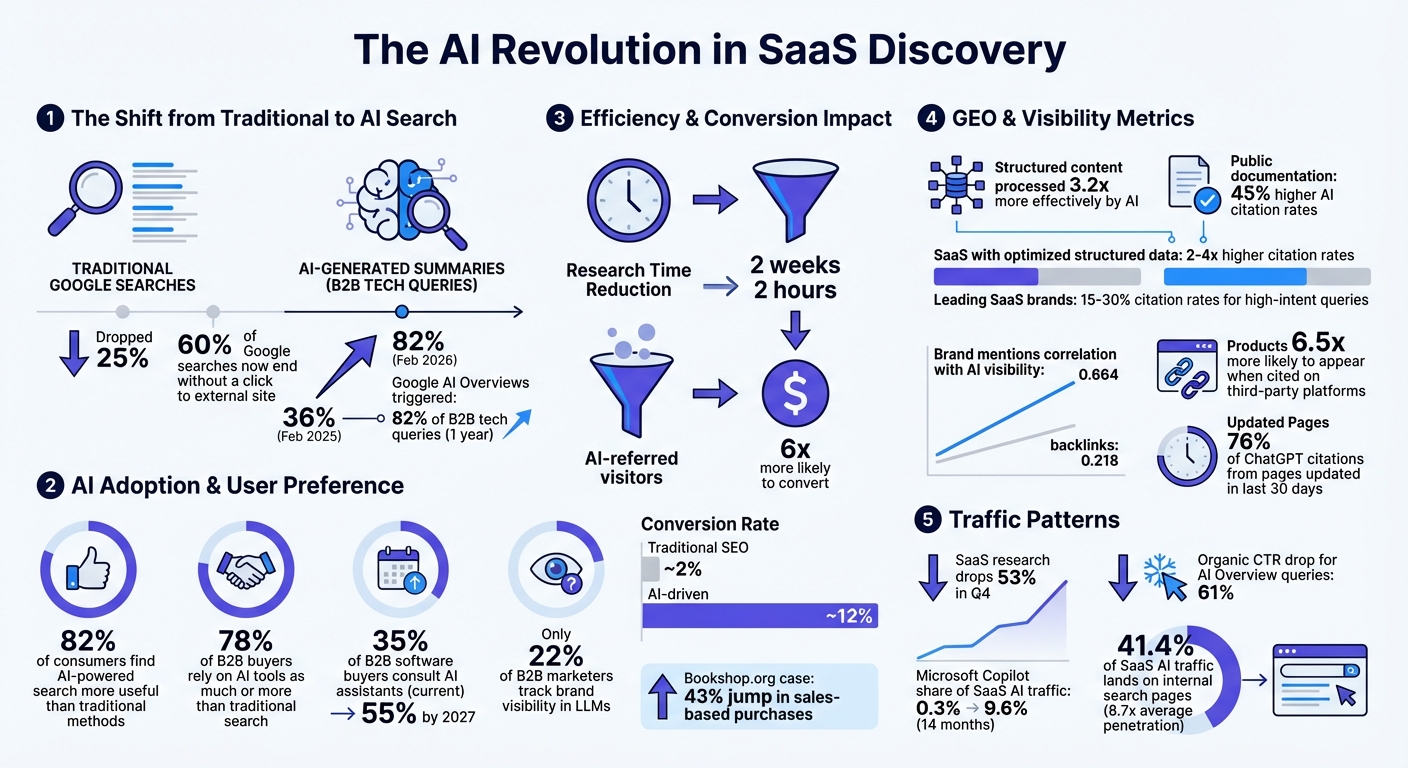
Finding the right software no longer requires endless tabs and confusing comparisons. SaaS search engines, powered by AI, simplify this process by delivering tailored, concise recommendations instead of scattered links. Between February 2025 and February 2026, AI-generated summaries for B2B tech queries surged from 36% to 82%, while traditional Google searches dropped by 25%. Here's how SaaS search engines are transforming software discovery:
- Streamlined Search: AI tools understand user intent, breaking down complex queries into actionable insights.
- Faster Decision-Making: Research that once took weeks now takes hours, with tools like Retrieval-Augmented Generation pulling data from trusted sources.
- Increased Accuracy: Techniques like query expansion and structured data ensure precise, reliable results.
- Generative Engine Optimization (GEO): SaaS providers must now optimize for AI visibility by making content machine-readable and clear.
- Improved Conversion Rates: AI-referred visitors are six times more likely to convert compared to traditional search traffic.
AI-powered SaaS discovery tools are reshaping how businesses find and evaluate software. The focus has shifted from ranking high on Google to being cited in AI-generated answers, requiring companies to adapt their strategies for this new search landscape.
AI-Powered SaaS Discovery: Key Statistics and Impact on B2B Software Search
How AI-Powered Search Improves Discovery and Decision-Making
AI-powered search engines go beyond simple keyword matching - they grasp intent and provide tailored results. Instead of forcing users to sift through multiple tabs, these tools pull together insights from various sources, presenting concise shortlists with clear reasoning. This shift has been transformative: 82% of consumers now find AI-powered search more useful than traditional methods. By focusing on intent, these tools streamline the discovery process, offering precise recommendations.
What sets AI search apart is its ability to break down complex queries. Using a process called "Query Fan-Out", these engines split a single question into numerous related sub-queries, running them all at once. For example, if you ask, "What CRM fits a 20-person startup with Slack integration?" the system simultaneously searches for pricing details, integration features, user reviews, and technical specs. This ensures the final recommendation addresses every angle of the question.
Delivering Synthesized Results with AI
Instead of presenting entire webpages, AI search focuses on extracting and combining key pieces of information. It might pull a pricing table from one site, feature details from another, and user feedback from Reddit, weaving these into a cohesive response. This is powered by Retrieval-Augmented Generation (RAG), which uses real-time data from trusted sources to ground its answers, reducing inaccuracies.
The benefits are clear. Tasks that once took weeks can now be completed in hours. Research shows that a two-week research phase can shrink to just two hours. For businesses, this means quicker decisions and better resource use. For instance, Bookshop.org adopted AI-powered search in their inventory of six million items and saw a 43% jump in sales-based purchases, thanks to more relevant search results.
"We used to optimize for humans who use Google. Now we're optimizing for AI that reads Google for humans".
This efficiency directly tackles the challenges of software discovery mentioned earlier.
Improving Accuracy Through Query Expansion
While synthesized data makes results clearer, query expansion sharpens accuracy by bridging the gap between how users phrase their needs and how vendors describe their offerings.
Query expansion addresses a common issue: the disconnect between user language and technical product descriptions. AI models use methods like Chain-of-Thought (CoT) reasoning, which breaks queries into logical steps, generating detailed results with precise terminology for better document matching. This approach increases the likelihood of finding the right document in the top 1,000 results from 87.82% to 90.61%.
Another technique, Query2Doc, creates a "mock" answer to a user's query, identifying keywords that are most likely to appear in high-quality sources. This method improves performance by 3% to 15%. For longer, more detailed searches - which trigger AI Overviews 57% of the time, nearly three times more than shorter queries - this precision is vital. The system cross-references vendor claims with third-party sources like G2, Reddit, and technical documentation, ensuring users get reliable, well-matched solutions.
sbb-itb-e3aed85
Optimizing SaaS Product Visibility Through Generative Engine Optimization (GEO)
Generative Engine Optimization (GEO) is reshaping how SaaS companies ensure their products are discovered in an AI-driven world. With AI-powered search tools like ChatGPT and Perplexity becoming key players in user research, the focus has shifted. It's no longer just about ranking high on Google - it's about being cited in AI-generated answers. Currently, 35% of B2B software buyers consult AI assistants during their purchase research, a number expected to grow to 55% by 2027.
The concept behind GEO is straightforward: AI systems process structured content far better than unstructured marketing copy - 3.2 times more effectively, to be precise. This means SaaS providers must ensure their product information is machine-readable, not just human-readable. Ryan Jones, Director of SEO at Razorfish, sums it up perfectly:
"We used to optimize for humans who use Google. Now we're optimizing for AI that reads Google for humans".
Boosting Exposure Through Structured Data
Structured data is the bridge between your website and AI engines. Instead of viewing your content as a block of text, AI tools extract specific details like pricing tiers, features, and customer ratings to generate precise answers. SaaS companies that optimize their structured data for AI see 2-4x higher citation rates in AI-generated responses.
To make your content AI-friendly, implementing schema markup is key. Here are some essential schema types and their roles:
| Schema Type | Purpose for AI Discovery |
|---|---|
| SoftwareApplication | Defines software category, platform requirements, and application suite |
| Product | Highlights features, pricing, and availability |
| AggregateRating | Provides trust signals with review scores from platforms like G2 or Capterra |
| FAQ | Marks up common questions for direct citation in AI responses |
For instance, SaaS providers who maintain public, well-structured documentation see 45% higher AI citation rates for technical and integration-related queries. This means keeping API documentation and key feature lists accessible without requiring a login, as AI crawlers can’t bypass gated content.
Transparency is also critical. AI systems prioritize products with clear pricing and structured breakdowns over vague descriptions. When AI tools use techniques like Query Fan-Out - splitting complex questions into smaller queries - schema markup ensures your product's data is discoverable and accurate. These efforts form the backbone of an effective GEO strategy.
Metrics on GEO Success
Measuring GEO success requires looking beyond traditional SEO metrics. One of the most important indicators is citation frequency - how often your brand appears in AI-generated responses on platforms like ChatGPT and Perplexity. Leading SaaS brands currently achieve citation rates of 15% to 30% for high-intent category queries.
Another key metric is Share of Synthesis, which tracks how often your brand is sourced compared to competitors when AI generates an answer. This is vital because organic click-through rates for queries that trigger AI Overviews have dropped by 61%, with users increasingly relying on AI-generated answers instead of visiting websites.
However, only 22% of B2B marketers currently track their brand's visibility within large language models. This lack of tracking creates a blind spot, especially since much of the AI-driven discovery process happens in the "dark funnel" - conversations and decisions made before users even visit a website. To succeed in this new landscape, SaaS companies must aim to be the solution recommended by AI, not just another name on a search results page.
Data-Driven Precision in Matching SaaS Solutions to User Needs
The way SaaS search engines connect buyers with the right products has taken a leap forward. Instead of just matching keywords to pages, AI-powered discovery tools now dive into millions of data points - like user reviews and community feedback - to better understand what buyers need. The result? 78% of B2B buyers now rely on AI tools as much or more than traditional search engines for researching software.
A key factor here is entity clarity, which ensures consistent descriptions of product features, billing and pricing, and capabilities. Platforms like G2, Capterra, and Reddit provide structured data that AI systems extract to directly answer user questions - often without the need for a website visit , a capability often powered by open source chatbot solutions. This precision stems from advanced data extraction methods that prioritize clarity and consistency.
The impact is clear: visitors referred by AI are 6 times more likely to convert compared to standard organic traffic. These users arrive pre-qualified, thanks to AI engines that deliver curated shortlists of 3-4 options, complete with reasoning behind each recommendation. As James Campigotto from Software Finder explains:
"Visibility alone is no longer enough. What matters now is how directly you meet buyer intent".
Comparing Rules-Based vs. AI-Driven Discovery Methods
The shift toward AI-driven discovery highlights stark differences from traditional SEO approaches. While rules-based systems focus on keyword rankings and backlinks, AI-driven methods emphasize mentions, citations, and accuracy across diverse sources.
| Feature | Rules-Based (Traditional SEO) | AI-Driven (Generative Search) |
|---|---|---|
| Primary Goal | Rank well in search results | Be cited and recommended in answers |
| User Experience | Skimming lists of websites | Receiving synthesized shortlists |
| Conversion Rate | ~2% | ~12% (6x higher) |
| Key Metric | Traffic and keyword rankings | Mentions, citations, and accuracy |
| Scalability | Limited by manual tagging/keywords | High; processes thousands of data points |
| Trust Factor | Users skim lists of blue links | Users trust direct, curated shortlists |
The numbers back it up: brand mentions have a 0.664 correlation with AI visibility, while traditional backlinks only show a 0.218 correlation. Products are also 6.5 times more likely to appear in AI-generated answers when cited on third-party platforms rather than their own websites.
Using Behavioral Insights for Better Recommendations
AI search engines don’t just stop at data - they use behavioral insights to refine their recommendations. For instance, 41.4% of SaaS AI traffic lands on internal search pages instead of product-specific pages. This happens because AI engines often use site search bars as a fallback when specific data is missing. That’s 8.7 times the average site penetration rate.
Keeping content up-to-date is also crucial. 76% of ChatGPT citations come from pages updated in the last 30 days, making outdated product information practically invisible to AI-driven searches. AI systems also check for semantic consistency - whether a brand’s self-description aligns with external reviews and community discussions. When these match, the AI gains more confidence in recommending the product.
Discovery patterns follow seasonal trends too. SaaS research hits its peak in July but drops 53% in Q4 as companies wrap up budgets and head into holiday breaks. AI engines understand these rhythms, recognizing that lower activity in Q4 isn’t a failure of the discovery process - it’s simply a reflection of typical B2B buying cycles.
All SaaS Software Directory: A Case Study in Facilitating SaaS Discovery
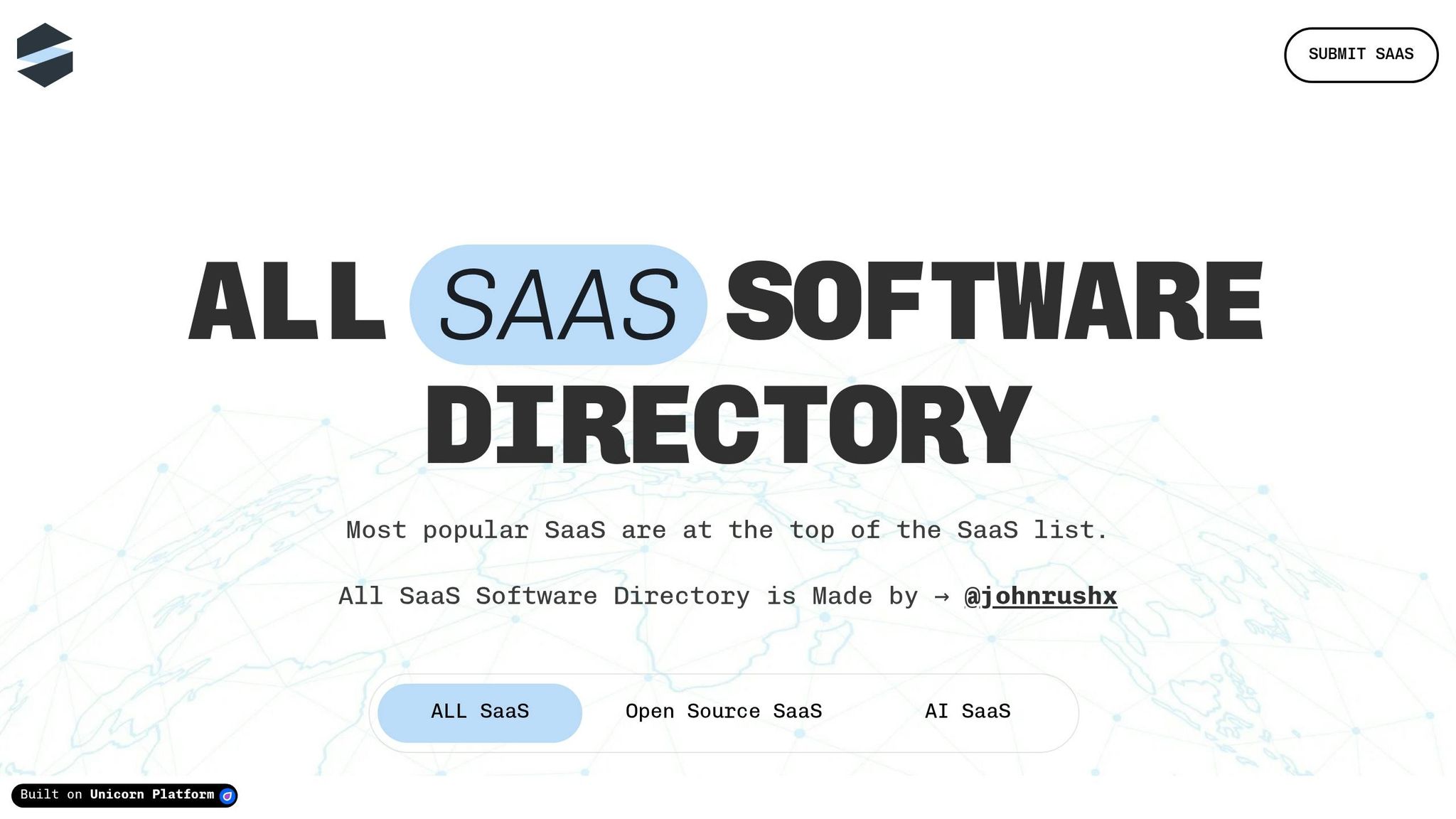
The All SaaS Software Directory, curated by John Rush, puts the principles of effective SaaS discovery into action. By using structured categorization and a data-driven ranking system, it tackles the "paradox of choice" many face when selecting software. This approach demonstrates how organizing tools into specialized collections can simplify the decision-making process.
Curated Listings for Easy Discovery
One of the standout features of this directory is its ranking system, which uses traffic and popularity metrics to highlight the best SaaS tools for modern businesses. Instead of relying on a static alphabetical list, the platform ranks tools based on their current market presence. For instance, major players like Adobe (280M monthly visitors), Notion (155.4M), Shopify (120M), and Salesforce (82.8M) are listed alongside rising startups. This snapshot of traffic data gives buyers a clear sense of which tools are making waves in their industries.
The directory’s categories cover a wide range of sectors, from ecommerce and healthcare to software development. Each listing is concise and packed with key metrics, making it easy to scan and understand. This format aligns with how AI-driven searches process and present information. Plus, the real-time search and filtering system allows users to refine their searches, whether they’re looking for billing tools or communication platforms , or exploring open-source ecommerce solutions. These features not only simplify the search process for buyers but also boost visibility for SaaS providers.
Enabling Exposure for SaaS Providers
For SaaS companies, the directory offers two submission options. The free submission includes a no-follow link but requires up to three months for review. Alternatively, a one-time $49 premium submission ensures immediate publication and a permanent do-follow backlink, which can improve SEO.
This dual-submission model benefits both buyers and providers. As TinyHunt puts it:
"For SaaS innovators, the directory acts as a powerful launchpad, offering quick exposure to thousands of potential users and simplifying marketing efforts."
To keep users engaged, the platform also sends out monthly email updates featuring new additions. This combination of categorized listings, traffic-based rankings, and direct submission options showcases how modern directories can connect innovative software solutions with the buyers actively searching for them.
Conclusion
AI-powered discovery is reshaping how businesses find and evaluate SaaS solutions. Today, nearly 60% of Google searches end without a click to an external site, highlighting a shift toward direct, synthesized answers. These answers often compare features, pricing, and user sentiment in real time, drawing from structured review data, technical documents, and user-generated content on platforms like Reddit and G2. This demand for accurate and relevant information has set the stage for the rise of GEO.
Generative Engine Optimization (GEO) marks a major change in how search engines evaluate content. Contextual authority and citation density now outweigh traditional factors like backlinks. Over the past year, the percentage of B2B tech queries triggering Google AI Overviews skyrocketed from 36% to 82%. Success in this new environment depends on optimizing for machine readability, maintaining positive sentiment across third-party platforms, and offering the technical depth that AI models consider authoritative.
Platforms such as the All SaaS Software Directory illustrate how structured, data-driven tools can connect buyer intent with vendor visibility. By utilizing traffic-based rankings, categorized listings, and direct submission options, these directories act as vital sources for AI engines while simplifying decisions for buyers. This approach highlights the evolution of SaaS discovery, where structured data and AI-friendly content now dictate which solutions gain traction.
Looking ahead, SaaS discovery is becoming seamlessly integrated into everyday workflows. Tools like Microsoft Copilot have seen their share of SaaS AI traffic grow from 0.3% to 9.6% in just 14 months. Discovery now happens within tools like Excel and Slack, meaning SaaS providers must focus on being visible, credible, and frequently cited across the platforms where AI gathers its data. As Ankit Agarwal from Gracker.ai aptly puts it:
"The winners in this new landscape won't be the ones with the most backlinks; they will be the ones who optimize for answers".
FAQs
How do SaaS search engines figure out my intent?
SaaS search engines use sophisticated methods like intent parsing to figure out what you’re really looking for. This involves breaking down natural language queries to pinpoint your actual goal. On top of that, they rely on AI to analyze context and recognize patterns, which helps them suggest SaaS solutions that align with your needs.
For example, when you search for specific features or workflows, these engines can interpret those nuanced requests. This means they’re not just matching keywords - they’re tailoring results to make discovery easier and more relevant for you.
What is GEO, and how do I optimize for AI citations?
Geographic Optimization, or GEO, is all about boosting your visibility in AI-generated search results by customizing your content and citations for specific regions. To make the most of Generative Engine Optimization (GEO) strategies, focus on these key areas:
- Structure your content for large language models: Make your content organized and easy for AI tools to process and understand.
- Ensure external consensus: Align your information with trusted external sources to reinforce credibility.
- Improve entity clarity: Clearly define your brand, products, and services so AI systems can recognize and reference them accurately.
By following these steps, you increase the chances of AI tools citing your brand, giving you a better shot at reaching high-intent buyers early in their decision-making journey.
How can I measure AI visibility beyond SEO traffic?
To gauge how visible your brand is beyond traditional SEO traffic, start by exploring its presence on AI-driven platforms like ChatGPT, Claude, or Perplexity. Run relevant prompts or queries to see if these systems mention your product or brand. This can give you insights into how well your brand is integrated into AI-powered interactions.
Additionally, keep an eye on trends in AI-driven discovery. For example, track changes in conversion rates coming from AI platforms or tools. You can also analyze how often your brand is referenced in AI-generated conversations. These insights can help you fine-tune your strategies and boost your brand's visibility in this emerging space.