Private video hosting is essential for businesses that need secure, controlled, and compliant platforms for sharing video content, including product videos. Unlike public platforms like YouTube, these services offer advanced security, privacy, and integration features tailored to organizational needs. Here's a quick look at 8 top SaaS platforms and what they offer:
- VIDIZMO EnterpriseTube: Advanced security (AES-256 encryption, DRM), compliance with regulations like HIPAA and GDPR, and hybrid deployment options.
- Vbrick: Known for FedRAMP certification and new C2PA standards for video authenticity.
- Panopto: Ideal for training and education with role-based access and Section 508 compliance.
- Brightcove: Offers studio-grade DRM, ISO 27001 certification, and strong marketing integrations.
- Vimeo Enterprise: Popular for its polished interface, SSO support, and scalable live streaming.
- Wistia: Focused on marketing with tools for lead generation and viewer analytics.
- SproutVideo: High security with features like dynamic watermarking and IP restrictions.
- Dacast: Affordable with a China hosting license and strong encryption measures.
Quick Comparison
| Platform | Security Features | Compliance Certifications | Deployment Options | Best For |
|---|---|---|---|---|
| VIDIZMO EnterpriseTube | AES-256, DRM, SSO, audit trails | HIPAA, GDPR, CJIS, FedRAMP | Cloud, on-premises, hybrid | Regulatory industries |
| Vbrick | FedRAMP, C2PA, granular controls | GDPR, HIPAA, Section 508 | Private cloud | Government and compliance |
| Panopto | RBAC, SSO, watermarking | SOC 2, Section 508, FERPA | Cloud, on-premises | Education and training |
| Brightcove | Studio-grade DRM, IP restrictions | ISO 27001, GDPR | Multi-CDN | Marketing and content protection |
| Vimeo Enterprise | SSO, AES-256, DRM | SOC 2, GDPR | Global CDN | Scalable video streaming |
| Wistia | Password gates, domain restrictions | SOC 2, GDPR | Cloud | Marketing and lead generation |
| SproutVideo | Watermarking, tokenized access | GDPR, SOC 2 | Cloud | Secure mid-range hosting |
| Dacast | AES-256, MFA, DRM | GDPR, HIPAA, PIPL | Multi-CDN | Affordable global hosting |
These platforms cater to different needs, from regulatory compliance to marketing-focused tools. Choose based on your security, scalability, and integration requirements.
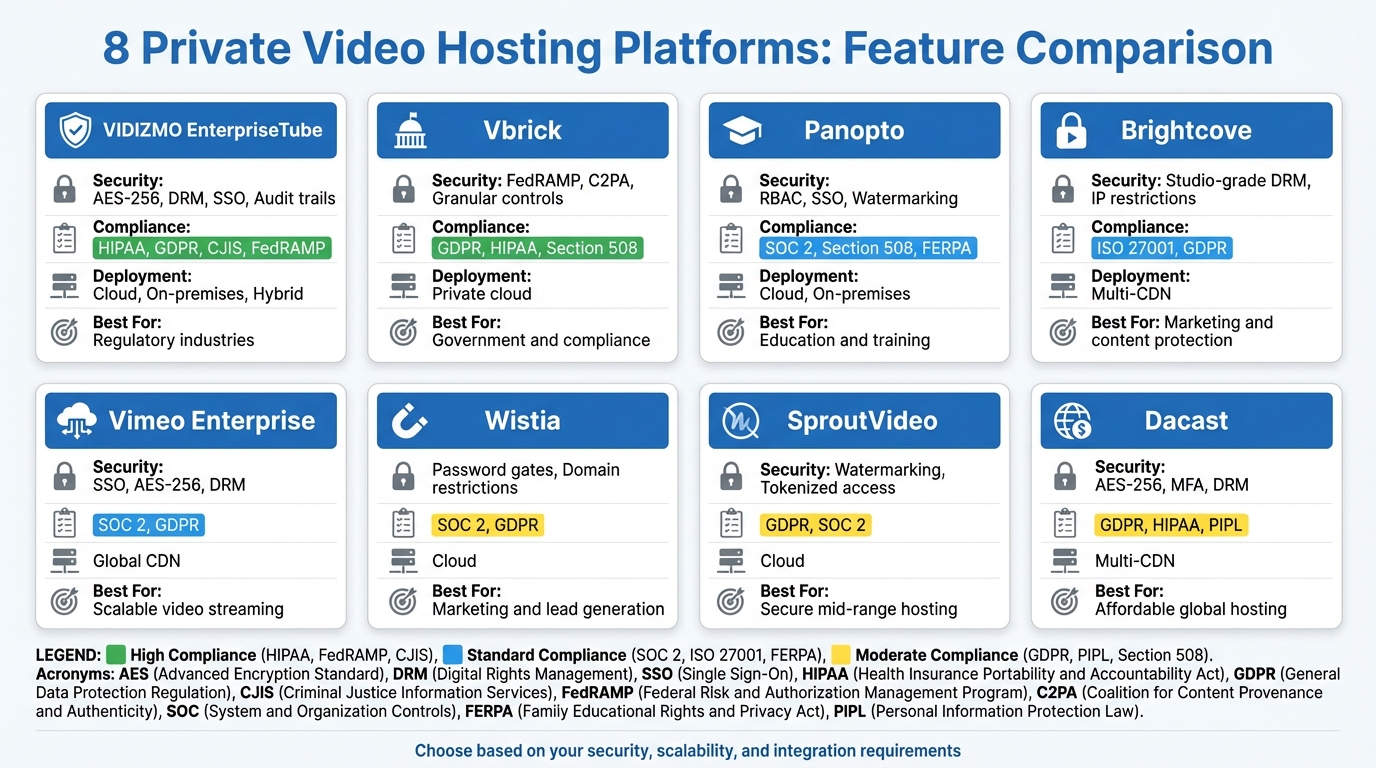
Comparison of 8 Private Video Hosting Platforms for Businesses
12 Best Private Video Hosting Services
sbb-itb-e3aed85
1. VIDIZMO EnterpriseTube
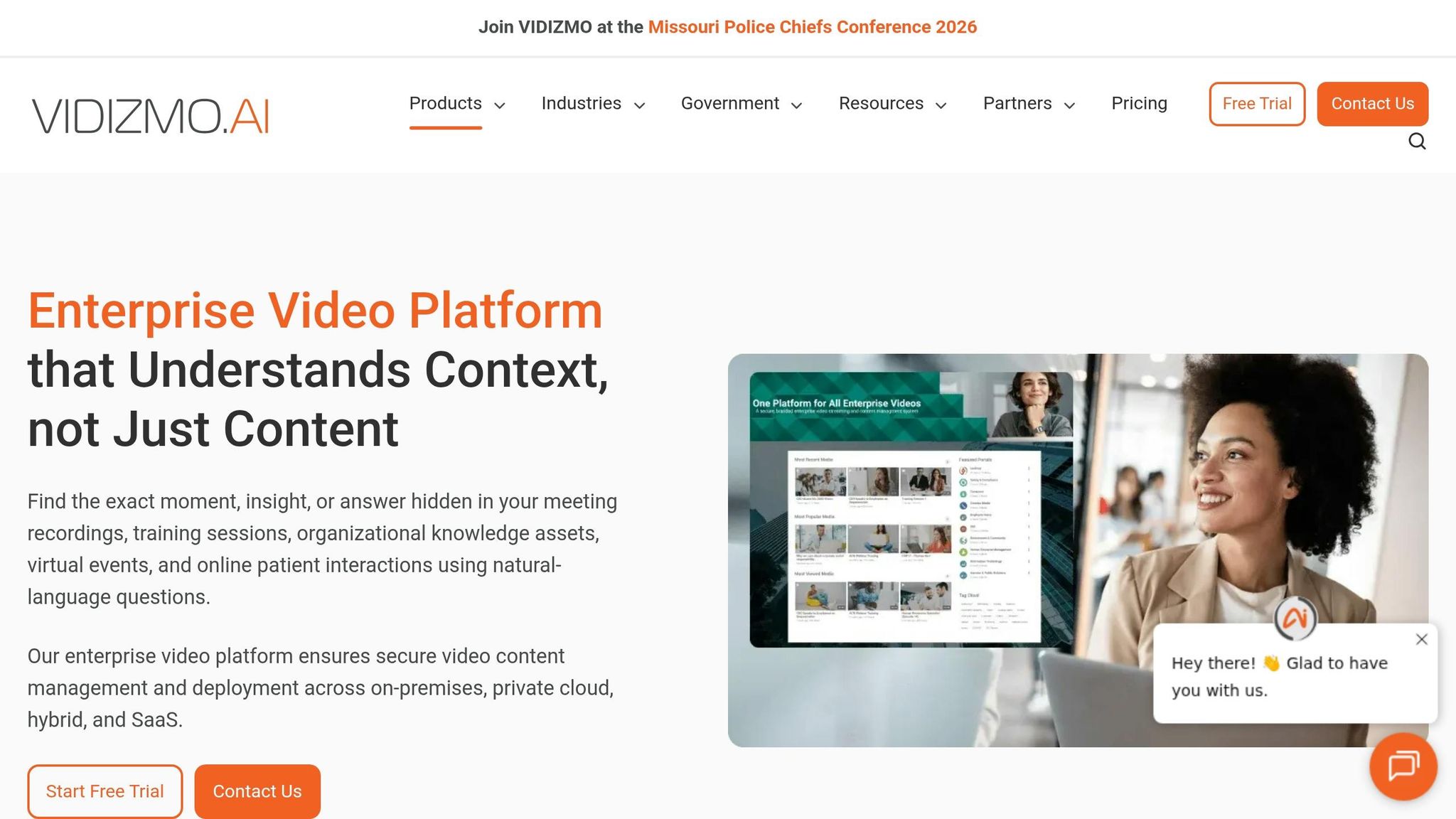
VIDIZMO EnterpriseTube is tailored for organizations that require strict control over their video content, making it a perfect fit for businesses prioritizing privacy and regulatory compliance. The platform supports over 255 file formats and can manage video libraries at the terabyte scale. Recognized by Gartner as a top-tier enterprise video platform, it’s trusted by high-profile organizations like the US State Department and NEC Japan. Its robust capabilities are backed by an array of advanced security and compliance measures.
Security Features
To protect data, VIDIZMO employs AES-256 encryption for stored content and SSL/TLS encryption for data in transit through HTTPS. Premium content protection is ensured with DRM support for Widevine, PlayReady, and FairPlay. Additionally, the platform uses AI-powered redaction to automatically blur sensitive elements like faces, license plates, and other custom objects in videos, safeguarding personally identifiable information.
Compliance Support
VIDIZMO adheres to numerous regulatory frameworks, including GDPR, HIPAA, CJIS, SOC 2, FIPS 140-2, FedRAMP, FERPA, and PCI-DSS. It offers robust access control features such as role-based permissions with six predefined roles, IP and domain restrictions, geographic limitations, and URL tokenization for expiring links with view limits. Audit trails are stored in tamper-proof WORM-enabled storage, which is critical for legal compliance in cases like CJIS and FOIA requests. Breach notifications are issued within two business days.
For example, White & Case LLP, a global law firm, uses VIDIZMO for confidential employee training. By integrating SSO and role-based access, they ensured that only authorized personnel could access sensitive materials, meeting GDPR and HIPAA compliance requirements.
Scalability
VIDIZMO doesn’t just meet compliance needs - it also ensures smooth video delivery on a global scale. Its multi-CDN architecture supports both live and on-demand streaming, while adaptive bitrate streaming (HLS and MPEG-DASH) guarantees seamless playback across varying internet speeds. The platform handles bulk uploads efficiently and provides AI-powered faceted search to navigate large video libraries. Deployment options include cloud (AWS/Azure), on-premises, or hybrid setups, with features remaining consistent across all models.
Microsoft's David Chou highlighted the platform’s value:
EnterpriseTube brings everything together in a seamless way. We had pieces of enterprise video in different systems, but nothing that unified it all. EnterpriseTube finally gave us one platform for everything video.
Integration Capabilities
VIDIZMO integrates seamlessly with various tools and platforms. It works with LMSs like Moodle and Canvas via SCORM and LTI 1.3, video conferencing tools such as Zoom, Microsoft Teams, and Webex, as well as CRM and CMS systems. The platform supports Single Sign-On (SSO) with over 25 providers, including SAML, OIDC, LDAP, Azure AD, and Okta. It also uses SCIM 2.0 for automated user provisioning and de-provisioning, ensuring that access is revoked immediately when employees leave the organization.
2. Vbrick
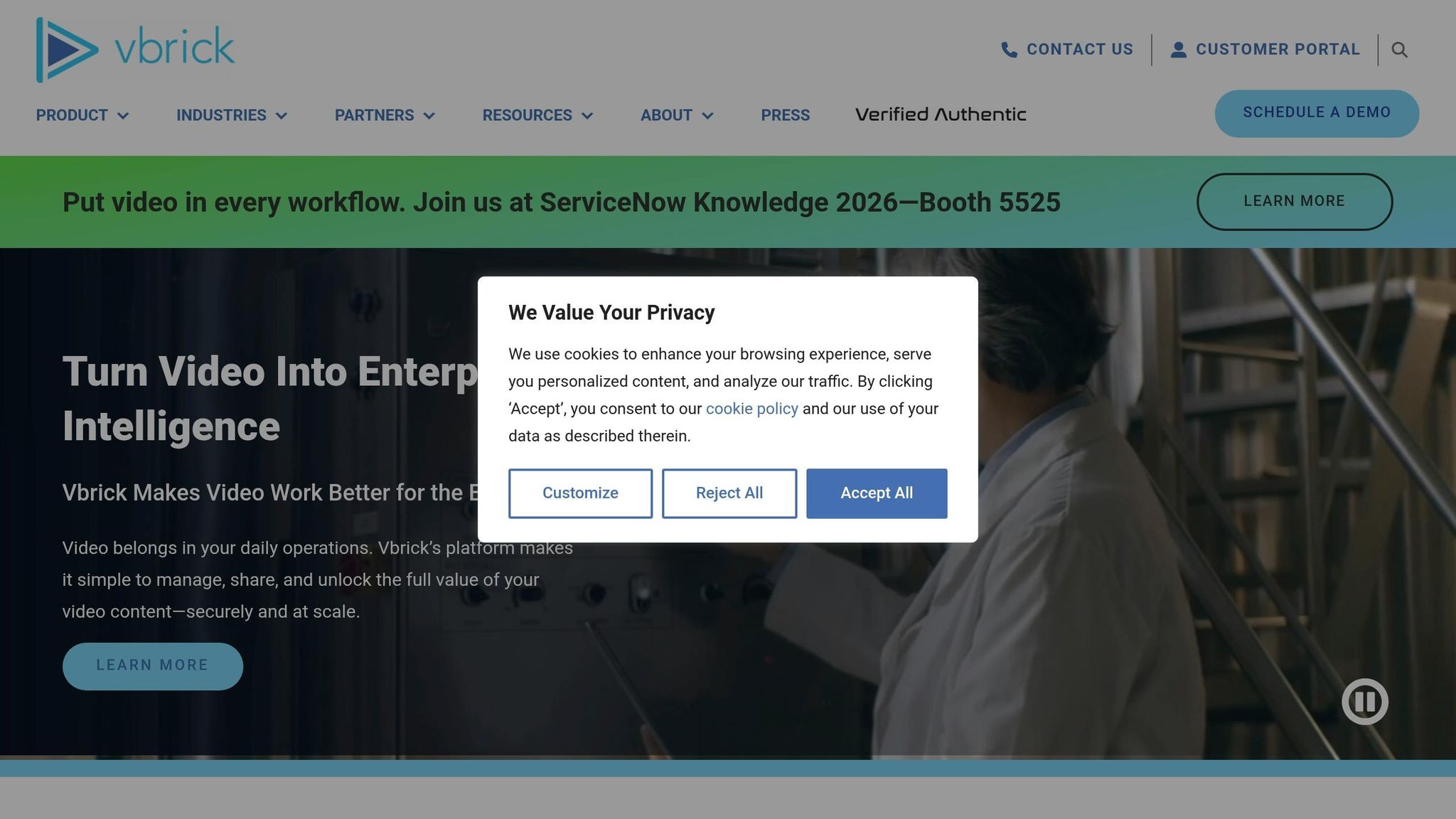
Vbrick stands out as a secure video platform that prioritizes compliance and advanced certifications. It holds the distinction of being the only FedRAMP-certified enterprise video platform and, as of February 2026, the first to achieve C2PA conformance. This recognition ensures video authenticity and identifies AI-generated content, addressing the growing need for transparent media practices.
Security Features
Vbrick offers a range of advanced security measures to control access and protect content. Its granular access controls allow administrators to set specific permissions for users, groups, or channels. The "All Internal Users" feature ensures that only authenticated account holders within the organization can access the corporate video portal and learning systems. For external sharing, administrators have tools to:
- Assign user-specific permissions
- Enable password protection
- Create expiring links with customizable expiration dates
- Revoke access when necessary
These layers of security make it easier to manage video content while maintaining strict access protocols.
Compliance Support
By adopting C2PA standards early, Vbrick takes a proactive approach to addressing new risks and regulatory requirements. It is currently the sole enterprise video platform implementing this standard. The platform integrates digital content credentials, providing a verifiable history for video files. These credentials, coupled with detailed audit trails and logging, ensure compliance with GDPR by offering visibility and accountability for data access. Additionally, the Trusted Access feature supports secure integrations with external business tools, ensuring video content remains restricted to specific third-party environments.
Integration Capabilities
Vbrick seamlessly connects with widely-used platforms like Microsoft Teams, Webex, and AWS to enable secure communication and video workflows. Its Video Platform as a Service (VPaaS) allows developers to embed secure video functionalities into custom business applications using APIs. For large-scale internal events, Vbrick's eCDN options - such as multicast, peer-to-peer, and edge caching - help prevent network congestion while ensuring encrypted video delivery. This combination of integration and scalability makes it a versatile choice for enterprises managing complex video needs.
3. Panopto
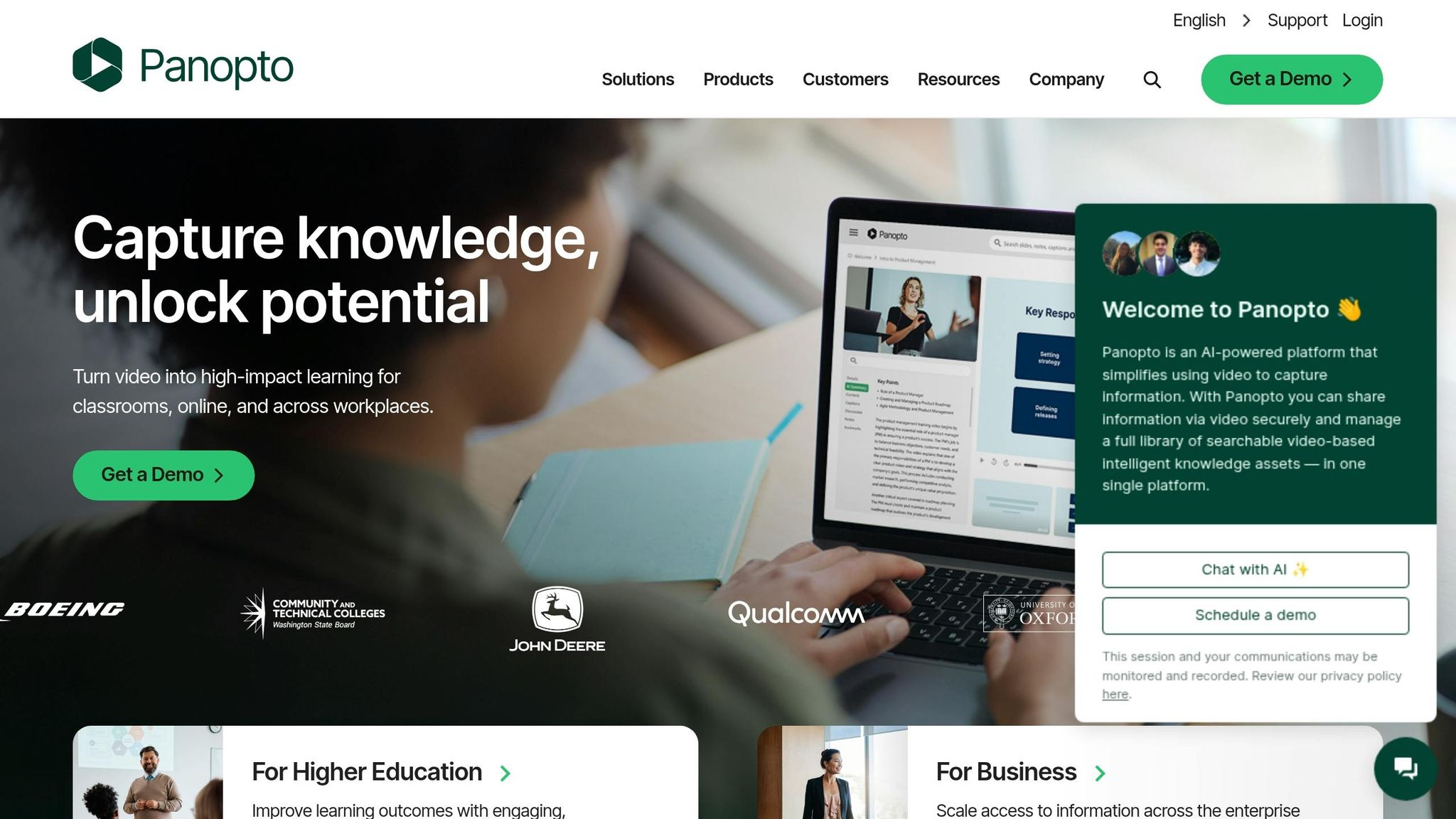
Panopto is designed as a secure, closed platform for video recording, storage, and sharing. Its focus on security and ease of use has made it a go-to choice for many Fortune 500 companies and educational institutions looking to manage training sessions, knowledge sharing, and lecture recordings.
Security Features
Panopto uses role-based access control (RBAC) to ensure that only the right people can view sensitive content. Administrators can assign permissions at various levels - whether it’s the entire library, specific folders, or individual videos - offering precise control over access. The platform also integrates with corporate authentication systems and supports Single Sign-On (SSO) through protocols like SAML, allowing employees to log in with their existing company credentials.
Compliance Support
For organizations that deal with sensitive information, Panopto is built to meet Section 508 compliance standards. It includes features such as automatic closed captioning and screen reader support, making its content accessible to all users.
Integration Capabilities
Panopto seamlessly integrates with major Learning Management Systems and supports widely used standards like SCORM and LTI 1.3. It’s also compatible with popular video conferencing tools like Zoom, Microsoft Teams, Cisco Webex, GoTo Meeting, and BlueJeans. Deployment is flexible too - whether you prefer cloud hosting via AWS, private instances on AWS or Azure, or an on-premises setup, Panopto has you covered. This flexibility enhances its position as a reliable, secure video hosting solution for enterprises.
4. Brightcove
Brightcove stands out as a trusted platform for enterprises focused on safeguarding their content. With over 2,500 businesses using it daily and more than 10 million videos streamed each month, Brightcove has become a go-to solution for secure video hosting. Its achievements include earning two Technology and Engineering Emmy® Awards in 2021 and maintaining an impressive 99% customer satisfaction rate. These attributes make it an ideal choice for businesses prioritizing privacy and security.
Security Features
Brightcove takes content security seriously, implementing advanced measures like proxy blocking to prevent access from anonymous networks, TOR exit points, and corporate VPNs. It also offers geo-restrictions, IP whitelisting, and domain controls to manage where and how content is accessed. A standout feature is mid-stream rights validation, which continuously checks viewer credentials during playback. If conditions such as stream concurrency limits are breached, the video is automatically stopped.
The platform's role-based access control (RBAC) allows administrators to assign specific permissions, limiting access to modules like Media, Publishing, Advertising, or Analytics. For data protection, Brightcove employs enterprise-grade encryption for data in transit (HLSe), ensures separation in its multi-tenant environment, and offers geographic master storage to meet data residency needs. Businesses can also restrict concurrent streams per user and use DRM-based device registration to prevent credential sharing. These measures are part of Brightcove's commitment to stringent security and compliance.
Compliance Support
Brightcove holds ISO 27001:2022 certification and is listed in the CSA STAR Level 1 registry. The platform aligns with GDPR regulations by pseudonymizing personal data and supports SOC 2 compliance standards. With piracy causing an estimated $47 billion to $115 billion in GDP losses annually in the U.S., Brightcove's focus on security addresses a pressing issue for businesses.
Integration Capabilities
Brightcove enhances its value through extensive integration options. It provides REST APIs, SDKs, and prebuilt connectors for smooth compatibility with web, mobile, OTT, and enterprise systems. Its Audience Sync feature integrates with marketing tools like Salesforce, HubSpot, Pardot, and Marketo, enabling businesses to launch campaigns and score leads based on video activity. Additionally, Brightcove supports direct publishing from CMS platforms, integrates with LMS and DAM systems, and offers SSO through SAML/OAuth and SCIM for managing user permissions.
5. Vimeo Enterprise
Vimeo Enterprise is a professional video hosting solution designed specifically for businesses. With over 4 billion minutes streamed and 7 million new video uploads each month, it’s built to handle the demands of enterprise-scale operations. The platform holds strong user ratings of 4.5/5 on both G2 and Capterra, with users frequently highlighting its polished interface and robust privacy controls. Like other private hosting options, Vimeo Enterprise focuses on security, scalability, and compliance to meet the needs of businesses.
Security Features
Vimeo Enterprise offers a range of security features to protect video content. It supports Single Sign-On (SSO) with SAML and SCIM provisioning through providers like Okta and Azure, simplifying user management. Data is safeguarded both in transit with TLS 1.2 (or higher) and at rest with AES 256 encryption. Privacy tools include password protection, private link sharing with privacy hashes, and domain-level embed restrictions, ensuring videos are accessible only on authorized platforms. Administrators also benefit from detailed access controls with workspace and folder permissions. To prevent unauthorized sharing, it employs Digital Rights Management (DRM) and forensic tracking. Media manager Taniya C. shared her experience:
The best option for privately hosting content safely and securely without much risk of unauthorized access or breaches is Vimeo.
Compliance Support
Vimeo Enterprise is equipped to meet stringent compliance requirements. It holds SOC 2 Type II and ISO 27001 certifications, offers HIPAA-capable features with Business Associate Agreements, and provides EU data residency options for GDPR compliance. Additionally, it is certified at TX-RAMP Level 2 for Texas state agencies and includes audit logs to support compliance monitoring. These certifications make it a strong choice for businesses in regulated industries that handle sensitive content.
Scalability
Built for growth, Vimeo Enterprise provides 5× more storage and 50× more bandwidth compared to standard plans. It supports high-resolution streaming, including 4K, 8K HDR, and Dolby Vision. The enterprise CDN ensures smooth, reliable broadcasts and allows for over three simultaneous live streams with backup capabilities. For instance, Paychex adopted Vimeo Enterprise with SSO for its 16,000 employees worldwide, resulting in a 900% increase in virtual event attendance and a 10× boost in reach. Joel Basa from Paychex explained:
Vimeo was differentiated from other platforms because of the security. We were looking to integrate from an enterprise level, and SSO was critical. Vimeo offers that.
Similarly, Garver connected over 1,300 employees across 60 offices in 20 states through daily video communications.
Integration Capabilities
Vimeo Enterprise enhances its value by integrating seamlessly with various business tools. It works with learning management system solutions via SCORM and xAPI support, helping businesses track training compliance and engagement. It also connects with CRM platforms like Marketo and Salesforce Marketing Cloud, linking video performance data to lead generation and customer success metrics. The Enterprise, Analytics, and Live APIs enable businesses to create custom workflows and integrate with Business Intelligence tools. Additionally, content can be centralized from platforms such as Zoom, Webex, Google Drive, Dropbox, and Box.
6. Wistia
Wistia is a video hosting platform tailored for businesses, trusted by over 440,000 customers. It’s specifically designed for companies aiming to maintain control over their branding, generate leads, and provide an ad-free viewing experience. This focus makes it a go-to choice for businesses leveraging video for customer engagement and lead generation. Users value its detailed analytics and user-friendly tools for managing extensive video and audio libraries.
Security Features
As a business-centric platform, Wistia emphasizes robust security measures. It safeguards content with features like universal password gates, domain restrictions, and locked folders. Expiring links allow users to set specific publish and expiration times, ideal for time-sensitive materials. By default, all Wistia accounts and media remain unlisted, preventing them from being indexed by search engines. The platform uses HTTPS for secure communication and ensures passwords are stored with unique salts and hashes. Additionally, Wistia complies with SOC 2 Type 1 and Type 2 standards and aligns with GDPR, CCPA, and the EU–US Data Privacy Framework.
Scalability
Wistia’s infrastructure is built for scalability, featuring a containerized architecture with sharded SQL databases and leveraging multiple Tier 1 CDNs via HLS. This setup ensures 99.9% uptime and smooth playback across various connection speeds. With over 230,000 servers in 130+ countries, the platform delivers reliable performance worldwide. Storage options range from 25 GB on the free plan to over 1 TB for enterprise users, with organization tools like folders, sub-folders, and custom tags.
In June 2022, Scarlett Bush, Director of Operations at Explainly, highlighted the platform’s impact, reporting a 17% increase in leads and a 116.67% rise in sales conversions after adopting Wistia. For live events, Wistia offers a Webinar add-on ($350/month), which supports live hosting, simulive (pre-recorded content presented as live), and RTMP ingest for streaming via external encoders. These features, combined with seamless integrations, make Wistia a powerful tool for marketing and event hosting.
Integration Capabilities
Wistia integrates directly with popular marketing and CRM platforms like HubSpot, Marketo Engage, and Pardot, enabling businesses to capture viewer data and generate leads. Its Turnstile feature allows users to collect names and email addresses directly within the video player, with the option to send the data to email marketing tools or export it as a CSV file. For tracking engagement, Wistia works with Google Analytics 4, providing insights into video performance alongside website metrics.
"Wistia's found the perfect balance for a video hosting platform. We use it for everything: lead capture for marketing videos, chaptered long-form webinars, internal documentation - the works".
M. Tre Gonzalez, Director of Growth at OnCourse Systems for Education, praised Wistia’s versatility. The platform also integrates with Zoom, automatically importing recorded meetings and webinars, and connects with Descript for easy video editing and export. For developers, Wistia offers a suite of APIs, including the Data API (REST) for actionable insights, the Player API for custom UI elements, and the Customize API for programmatic embed settings. These tools reinforce Wistia’s position as a comprehensive and secure video hosting solution for modern businesses.
7. SproutVideo
SproutVideo stands out as a private video hosting platform tailored for businesses that prioritize security and control. With a 4.8/5 star rating on Capterra and a 9.5/10 for ease of use, it’s clear that this platform is designed to meet the needs of companies handling sensitive or proprietary content, such as e-learning providers and B2B SaaS companies. Andrea M., the CEO of an e-learning company, shared her experience:
After careful research, we selected SproutVideo for both ease of use and robust security. Since we sell online courses, it's critical that our content be protected.
Security Features
SproutVideo offers a comprehensive suite of security measures to safeguard content from unauthorized access and theft. Key features include:
- Password protection for individual videos or entire sites.
- Viewer login protection, requiring unique credentials for each user, which allows precise tracking and control over access.
- Single Sign-On (SSO), available on Forest plans starting at $295/month, integrates with corporate identity systems for seamless enterprise access.
To deter leaks, the platform employs dynamic watermarking, embedding a viewer’s email, IP address, and session ID directly onto the video. Additionally, signed embed codes with timed expirations ensure stolen codes can’t be used on unauthorized sites. Businesses can further restrict access by whitelisting specific IP addresses or geographic regions, ensuring videos are only viewable in approved locations. By default, all videos are private and won’t appear in search engine results unless explicitly configured otherwise.
Scalability
SproutVideo is designed to grow with your business. Every plan offers unlimited storage and bandwidth, with overages charged at $0.06 per GB rather than cutting off service. The platform supports up to 8K resolution and 60 FPS, delivering smooth playback through a global CDN, no matter how many viewers or where they’re located. For live streaming, the Forest plan includes 480 minutes of input and 14,400 minutes of delivery, ensuring scalability for large audiences.
Integration Capabilities
SproutVideo also excels in its ability to integrate with other tools and platforms. It connects with over 30 popular tools like HubSpot, Salesforce, Zapier, and Mailchimp, streamlining workflows for marketing and communication teams. A RESTful API allows for custom workflows, including video uploads and analytics. For compliance, the platform provides detailed access logs and account audit logs, making it easy to track who accessed content and when - essential for meeting regulatory requirements. To address privacy concerns, the Player Privacy Mode disables tracking of personally identifiable information, ensuring GDPR compliance.
8. Dacast
Dacast is a business-focused video hosting platform that prioritizes security and global scalability. With pricing starting at $39/month, users get 2.4 TB of bandwidth and 500 GB of storage, making it suitable for both small businesses and larger enterprises. Lindsay George, CEO of ComeSee TV, shared:
"The support that Dacast offers is particularly good compared to other streaming providers, making them a clear choice for my business."
The platform combines security, compliance, scalability, and integration to deliver a comprehensive video hosting solution.
Security Features
Dacast takes private hosting seriously, offering a range of advanced security measures. It uses AES-128 or AES-256 encryption to protect video data during transmission. A dynamic token security system refreshes tokens every two minutes, blocking unauthorized link sharing. Beyond standard password protection, Dacast includes Multi-Factor Authentication (MFA) and even biometric login options for tighter access control. Additional features like geographic IP whitelisting and domain restrictions ensure only authorized viewers can access content. For video-on-demand, Digital Rights Management (DRM) prevents unauthorized downloading and redistribution - an essential feature considering piracy costs the industry nearly $30 billion annually.
Compliance Support
Dacast ensures compliance with major global regulations, including the EU's GDPR, U.S. HIPAA, and China's PIPL. What sets it apart is its rare license for video hosting in China, allowing businesses to securely deliver content through the Great Firewall to an audience of 1.4 billion people.
Scalability
To guarantee smooth streaming for unlimited viewers worldwide, Dacast relies on top-tier CDNs like Akamai and Limelight. The platform also supports adaptive bitrate streaming, which adjusts video quality - up to 4K - based on each viewer’s internet speed and device. For businesses managing extensive video libraries, bulk uploading via SFTP or direct S3 upload ensures faster transfers and scalable storage. Additionally, Scale and Custom plans include unlimited live channels, enabling enterprises to expand their broadcasts without limits.
Integration Capabilities
Dacast offers seamless integration with essential business tools, enhancing its usability. Full Video and Player API access allows integration with CRMs, LMS systems, and custom applications. SDKs are available for mobile app development, and the platform supports Zoom live streaming, enabling real-time broadcasting of meetings and webinars to larger audiences. A Open source CMS options like WordPress simplify embedding videos on websites, while RTMP ingest support connects with professional live encoders for more advanced streaming setups.
Platform Comparison Table
The table below outlines the key differences in security, compliance, scalability, and integration among eight private video hosting platforms. VIDIZMO EnterpriseTube and Vbrick stand out for their regulatory compliance, offering certifications like HIPAA, CJIS, and FIPS - making them well-suited for industries such as healthcare and government. On the other hand, Brightcove offers advanced content protection through studio-grade DRM technologies like Widevine, FairPlay, and PlayReady. Meanwhile, Wistia and Vimeo Enterprise excel in marketing integrations with tools like HubSpot and Salesforce, though they may not meet the strict audit trail requirements of highly regulated sectors.
Deployment flexibility is another important factor. VIDIZMO ensures full feature parity across cloud, on-premises, and hybrid deployments, making it a strong choice for organizations that need alternatives to cloud-only solutions. Additionally, Dacast stands out with its China video hosting license, enabling secure content delivery to an audience of 1.4 billion.
Here’s a quick reference table summarizing the platforms' core attributes:
| Platform | Security Options | Compliance Certifications | Scalability Features | Integration Support |
|---|---|---|---|---|
| VIDIZMO EnterpriseTube | AES‑256 encryption, RBAC, SSO, audit trails | HIPAA, GDPR, CJIS, FedRAMP, SOC 2, FIPS, Section 508 | Cloud, on‑premises, or hybrid deployment with feature parity | LMS (SCORM/LTI), Azure AD, Okta, full API |
| Vbrick | SSO, RBAC, controlled internal distribution | HIPAA, CJIS, GDPR, SOC 2, FIPS, Section 508 | Enterprise-grade infrastructure, private cloud options | Corporate communication tools, LMS, enterprise IT stacks |
| Panopto | SSO (Azure/Okta), authenticated environment, watermarking | SOC 2, Section 508, FERPA (education focus) | Searchable knowledge base, centralized video library | LMS (Canvas, Moodle), SSO providers, exportable audit logs |
| Brightcove | Studio-grade DRM (Widevine, FairPlay, PlayReady), AES‑128, SSO, IP/domain restrictions | ISO/IEC 27001, SOC 2, GDPR | Multi-CDN delivery, regional data storage, adaptive bitrate streaming | CRM (Salesforce), marketing automation (HubSpot, Marketo), Adobe Analytics |
| Vimeo Enterprise | SSO, password protection, domain locking | GDPR (lacks deep audit trails for regulated industries) | Global CDN, live event management | Slack, Zoom, Microsoft Teams, HubSpot |
| Wistia | Password protection, domain restrictions, email gates | SOC 2, GDPR (not designed for regulatory governance) | Adaptive streaming for HD/4K playback | HubSpot, Marketo, Salesforce |
| SproutVideo | Dynamic watermarking, IP/geo-blocking, SSO | Audit logs (high security for mid-range pricing) | Global CDN, real-time analytics, live and VOD support | API, webhooks, CMS, CRM, marketing automation |
| Dacast | AES‑128/256 encryption, tokenized access, DRM for VOD | GDPR, HIPAA, PIPL, China video hosting license | Multi-tier CDN (Akamai, Limelight), adaptive bitrate streaming | Video & Player API, Zoom live streaming |
This table highlights the diverse strengths of each platform, helping businesses evaluate their options based on security, compliance, scalability, and integration needs. Whether you’re looking for enterprise-grade solutions or marketing-focused tools, understanding these differences is key to making the right choice.
Conclusion
Choosing the right private video hosting platform depends entirely on your business needs. For industries like healthcare, government, and law enforcement, compliance with regulations such as HIPAA and CJIS is non-negotiable. Platforms like VIDIZMO EnterpriseTube and Vbrick stand out here, offering hybrid deployment options to meet these stringent requirements. On the other hand, businesses focused on marketing and lead generation will find platforms like Wistia and Brightcove invaluable, thanks to their deep CRM integrations and viewer-level analytics that directly support revenue tracking.
When it comes to content protection, features like Brightcove's DRM and SproutVideo's watermarking are critical for preventing screen recording and unauthorized sharing. For simpler access control, solutions like SSO and domain locking may suffice and could be more budget-friendly.
Cost is another key factor. While some platforms, such as Dacast and SproutVideo, provide clear pricing tiers, enterprise-level solutions like Brightcove often require custom quotes, with typical annual contracts averaging around $36,000. It's essential to weigh these costs against the platform's scalability and features to ensure you're getting the best value.
For organizations with strict data sovereignty requirements, deployment flexibility is crucial. If third-party cloud storage is off the table, platforms offering on-premises or hybrid solutions, like VIDIZMO, become essential. Additionally, businesses with a global audience should prioritize platforms with multi-CDN support and adaptive bitrate streaming to guarantee smooth playback across devices and regions.
Ultimately, the choice comes down to aligning the platform's strengths with your primary use case. For internal training, features like searchable transcripts and LMS integrations from platforms like Panopto are game-changers. Meanwhile, those focused on live event monetization will benefit from pay-per-view capabilities offered by platforms like Dacast. As Hassaan Mazhar, B2B SaaS Content Strategist at VIDIZMO, aptly puts it:
Private video hosting turns video from a risk into a governed asset.
The right platform doesn't just store your videos - it transforms them into a powerful business tool that delivers measurable returns.
FAQs
How do I choose the right private video hosting platform for my use case?
To pick the best private video hosting platform, focus on a few critical areas:
- Security and Privacy: Look for features like encryption, DRM (Digital Rights Management), and IP restrictions to ensure your content is protected.
- Delivery and Performance: Reliable streaming, custom domain options, and detailed analytics are essential for smooth and efficient video delivery.
- Budget and Scalability: Choose a platform with flexible pricing plans that can adapt as your needs grow.
If specific features like watermarking or compliance are important to you, make sure to check for those as well. Take advantage of free trials or demos to test the platform and ensure it aligns with your goals.
What security features matter most for preventing video leaks?
Keeping your videos secure is all about using the right tools and strategies. Here are some essential features to safeguard your content:
- Encryption: This ensures your videos are protected during storage and transmission, making them unreadable to unauthorized users.
- DRM Capabilities: Digital Rights Management (DRM) helps control how your videos are accessed and shared, adding an extra layer of protection.
- Access Controls: Implementing measures like password protection, signed URLs, domain locking, and IP restrictions lets you decide exactly who can view your content.
- Dynamic Watermarking: This feature embeds unique, trackable watermarks into your videos, discouraging leaks and making it easier to trace unauthorized sharing.
By combining these features, you can keep your videos private and limit access to only those with proper authorization.
Do I need cloud, on-premises, or hybrid video hosting?
Choosing the right video hosting solution - cloud, on-premises, or hybrid - depends on factors like security, control, scalability, and budget.
- Cloud hosting is ideal if you need scalability, quick setup, and low maintenance. It's a great choice for businesses aiming to minimize upfront costs and technical responsibilities.
- On-premises hosting gives you full control and enhanced security. However, it comes with higher initial costs and ongoing management requirements.
- Hybrid hosting bridges the gap by combining the strengths of both. Sensitive data stays on-premises for security, while the cloud handles scalability and broader access.
Consider your business's priorities and resources to determine the best fit.