Managing employee benefits in 2026 requires efficient, automated platforms that simplify enrollment, payroll integration, and compliance. This list highlights the top eight benefits administration platforms, each offering unique features to meet different business needs. Here's a quick breakdown:
- ADP: Known for its extensive carrier connections (900+) and real-time payroll integration. Offers AI-driven decision support and mobile-friendly access.
- Paycor: Combines payroll, HR, and benefits with a focus on mid-sized companies. Includes AI tools like "Ask Emma" for guided plan selection.
- Paylocity: Fully integrated HCM suite with personalized benefits recommendations and strong mobile capabilities.
- PlanSource: Specializes in benefits administration with real-time carrier updates and compliance tools like automated ACA reporting.
- bswift: Focuses on benefits with robust compliance tools, AI-powered dependent verification, and seamless carrier connections.
- Benefitfocus: Excels in centralized benefits management with real-time data integration and personalized enrollment guidance.
- Workday: A unified HCM platform offering automated workflows, compliance tracking, and a mobile-first approach.
- Zest Benefits: Designed for mid-sized to large businesses, with a user-friendly mobile app and real-time HRIS synchronization.
Each platform addresses specific challenges like compliance, data integration, and employee engagement. Startups might also consider Juno for Startups tools for AI-powered flexible benefits. Below is a quick comparison of their standout features:
Quick Comparison
| Platform | Carrier Connections | Compliance Tools | Mobile Access | Decision Support | Best For |
|---|---|---|---|---|---|
| ADP | 900+ (Real-time) | ACA, HIPAA, COBRA | Advanced App | AI Recommendations | All business sizes |
| Paycor | Thousands (via bswift) | ACA, COBRA | User-friendly | Basic AI Guidance | Mid-sized companies |
| Paylocity | API-based | ACA, HIPAA, COBRA | Optimized App | Personalized (Reclaim) | Small to mid-sized |
| PlanSource | Real-time (700+) | ACA, COBRA | Optimized App | AI Tools | Benefits-focused |
| bswift | API-based | ACA, HIPAA, COBRA | Optimized App | AI-powered Assistant | Large enterprises |
| Benefitfocus | Bi-directional APIs | ACA, HIPAA, COBRA | Reliable App | Personalized Guidance | Complex organizations |
| Workday | Hundreds (Cloud Connect) | Global ACA Reporting | Mobile-first | Total Rewards Dashboard | Large enterprises |
| Zest Benefits | UK-focused | UK-specific | Intuitive App | Standard Guidance | UK-based businesses |
These platforms cater to diverse needs, from small businesses to global enterprises. Choose based on your organization's size, compliance needs, and integration requirements.
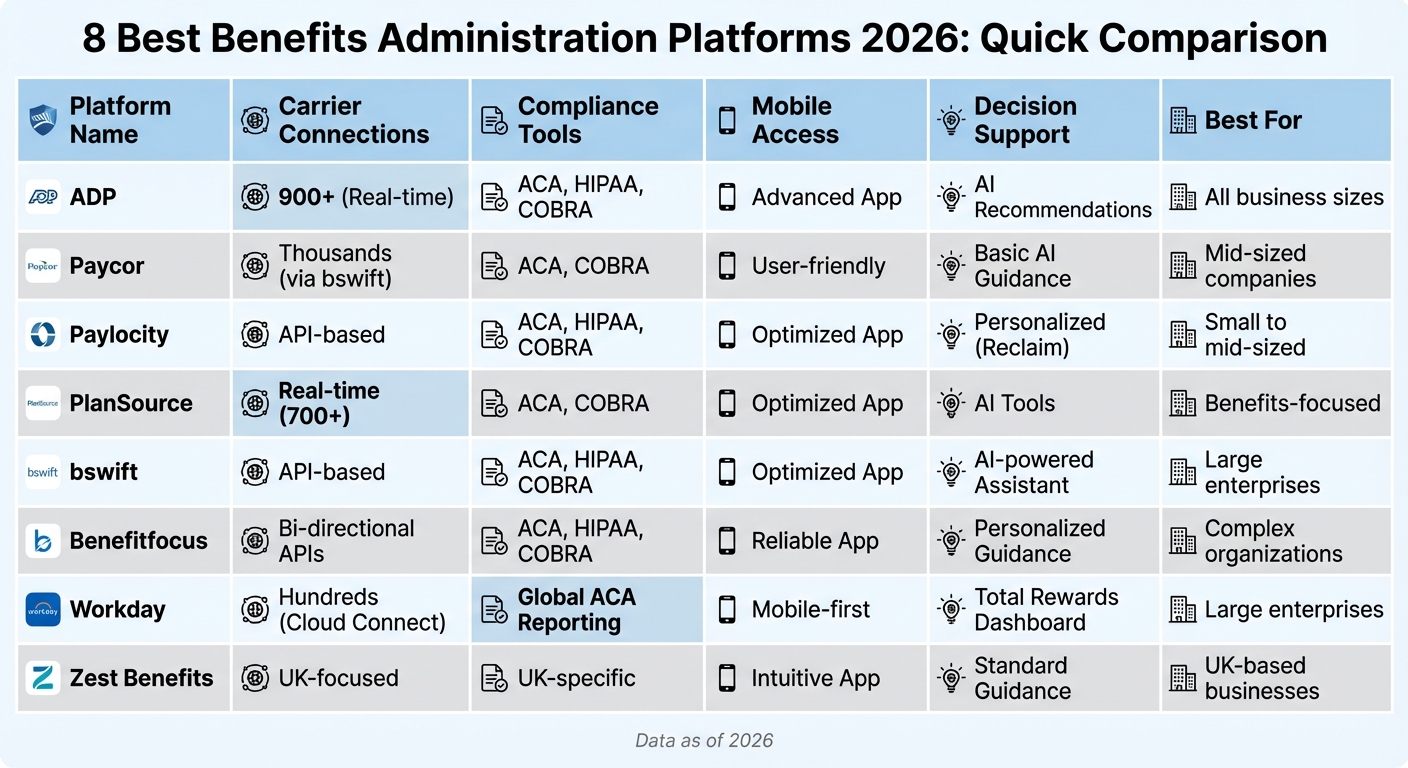
Benefits Administration Platforms 2026: Feature Comparison Chart
1. ADP
ADP combines benefits, payroll, and HR data into a single, unified database. This setup ensures that when employees update personal details - like a new address or marital status - those changes automatically sync across all modules. The result? No duplicate records or conflicting versions to worry about.
HCM Integration Level
ADP offers two deployment options to fit different organizational needs. If you're already using ADP for payroll, you’ll benefit from native integration, where benefits elections automatically sync with payroll deductions every pay period. For those using external HCM systems like Workday, Oracle, SAP, or Salesforce, ADP Vantage HCM provides prebuilt integrations. This flexibility allows businesses of all sizes to seamlessly connect their systems, no matter their setup.
Carrier Connections
ADP's carrier connectivity is powered by real-time APIs, linking the platform to over 900 insurance carriers. This means updates - such as enrolling in a new dental plan or adding a dependent - are transmitted instantly. This robust connectivity earned ADP recognition as an Overall Leader in NelsonHall's 2025 Benefits Administration assessment.
Compliance Tools
ADP goes beyond smooth integration by offering tools to help businesses stay compliant. Its SmartCompliance engine monitors regulations across 11,000 federal, state, and local jurisdictions. It handles tasks like filing IRS Forms 1094/1095, COBRA notices, and ERISA Form 5500 deadlines automatically. For example, starting January 1, 2026, new rules under H.R.1 will raise the pretax dependent care contribution limit to $7,500 for joint filers. ADP flags these changes early, helping businesses avoid penalties.
"When evaluating any AI tool, consider whether it was developed using secure, high-quality data, whether it produces reliable and meaningful results and whether it helps streamline - rather than complicate - work processes."
- Helena Almeida, Vice President, Managing Counsel and AI Legal Officer, ADP
Mobile Access
ADP also makes managing benefits easy on the go. The ADP Mobile Solutions app, rated 8.1 on TrustRadius, allows employees to handle open enrollment and make updates directly from their mobile devices. With 93% of users likely to repurchase and high satisfaction rates, the app is a favorite among users. Employees can compare plan options, update beneficiaries, and submit life event changes - all without needing a desktop.
"It's also nice to see your benefits that you elected and be able to do open enrollment for benefits via the app."
- Payroll Specialist
Decision Support Features
To simplify benefits selection, ADP leverages AI-driven recommendations. These tools suggest plans based on factors like family size, health needs, and budget. By breaking down plan details into easy-to-understand comparisons, the platform helps reduce confusion and the frequent question, "Which plan should I choose?" Pricing for the Enhanced Plan, which includes benefits administration and compliance alerts, starts at $149 per month plus $8 per employee.
2. Paycor
Paycor brings together recruiting, onboarding, payroll, and benefits into a single HCM platform, supporting more than 30,000 businesses and 2.3 million users. This all-in-one system ensures that benefit elections automatically sync with payroll deductions, removing the need for manual data entry or duplicate records.
HCM Integration Level
Paycor uses a unified data model to connect HR and payroll processes seamlessly. For example, when an employee selects a health plan during open enrollment, payroll deductions are automatically adjusted. For businesses using external tools like accounting software or applicant tracking systems, Paycor offers native integrations and robust APIs to ensure smooth connectivity. Its benefits administration module is tailored for mid-market companies, though some users have mentioned it feels more like an add-on than a fully integrated feature. Despite this, the system provides reliable carrier connections and compliance management tools.
Carrier Connections
Paycor integrates with thousands of insurance carriers through Electronic Data Interchange (EDI), ensuring real-time updates for enrollment changes. This automation eliminates the need for manual notifications, saving time and reducing errors.
Compliance Tools
Paycor offers tools to handle ACA tracking and reporting, including filing forms 1094-C and 1095-C. Interactive dashboards and proactive notifications help businesses stay on top of eligibility requirements and filing deadlines, making it a strong option for multi-state operations. Additionally, the platform includes built-in COBRA administration and HIPAA compliance features to further simplify regulatory management.
Decision Support Features
The platform includes "Ask Emma", an AI-powered virtual guide that helps employees navigate open enrollment. By providing personalized plan recommendations based on healthcare needs and budget, this tool reduces the number of routine benefits inquiries HR teams typically handle. Paycor also has a 4.4/5 rating on G2 and Capterra, with users frequently highlighting its intuitive and user-friendly design. Pricing is based on a tiered, custom model that depends on the number of users and selected modules.
3. Paylocity
Paylocity offers a fully integrated HCM suite where benefits, HR, and payroll work together seamlessly. This eliminates the need for manual data entry, ensuring a smooth flow of information from onboarding to payroll. The platform was recognized as the #1 HR Product in G2's 2024 Best Software Awards and received the 2025 Buyer's Choice honor from TrustRadius.
HCM Integration Level
With Paylocity, onboarding transitions effortlessly into benefits enrollment. Once a new hire completes onboarding, they’re automatically prompted to select benefits, which directly update their payroll information. As the VP of People & Culture at Upward Projects put it:
"Paylocity's a one-stop shop. The information flows from onboarding to HR to payroll. You're not playing with a bunch of different systems."
The platform’s Payroll Readiness Dashboard runs over 40 real-time audits, catching potential errors like missing tax IDs or unexpected pay changes before payroll is processed. Beyond internal systems, Paylocity connects smoothly with external carriers and platforms, thanks to pre-built integrations and open APIs that link to ERPs and 401(k) systems.
Carrier Connections
Paylocity simplifies processes by automatically generating and sending EDI files to insurance carriers. This eliminates manual data entry and reduces the risk of paying unnecessary premiums. The VP of HR at Green Lawn Pest Solutions shared the benefits:
"Everything is automatic and feeds into the payroll system. These connections were huge for us as they save us lots of time, all these processes have been simplified, and we can access everything we need from one place."
Compliance Tools
Paylocity’s centralized compliance dashboard helps businesses stay on top of regulatory requirements by consolidating compliance alerts and tasks in one place. Its AI Assistant provides guidance using verified sources from the Department of Labor and IRS. The platform also manages ACA compliance reporting, automated eligibility notifications, and acts as a Registered Reporting Agent for the IRS across all 50 states, Puerto Rico, the Virgin Islands, and Guam. Additionally, the Healthcare Training Bundle offers over 400 accredited, state-specific compliance courses through Paylocity’s Learning Management System.
Mobile Access
Paylocity’s mobile app allows employees to handle benefits enrollment, check HSA/FSA balances, and file claims - all from the same app they use to view paychecks and submit time-off requests. The Chief HR Officer at Coulee Bank emphasized the convenience:
"The Benefits module is so easy to use, and everything the employee needs is accessible in the same Paylocity app they are in daily to access pay checks or request time off. It's a huge relief and time savings for me!"
Administrators also benefit from mobile access, with a dashboard that provides real-time updates on enrollment statuses and alerts.
Decision Support Features
Paylocity’s Benefits Decision Support, powered by Reclaim, delivers personalized plan recommendations and detailed cost breakdowns during enrollment. This feature minimizes errors in elections and reduces the workload on HR teams during open enrollment. Pricing for Paylocity is tailored, based on the number of employees and selected modules, with a per-employee-per-month model.
4. PlanSource
PlanSource provides a targeted solution for benefits administration, catering to over 5,000 HR teams and 7.5 million users. Its platform integrates seamlessly with existing HR systems, earning accolades like the UKG 2025 Innovator of the Year for its advancements in connected benefits experiences.
HCM Integration Level
PlanSource integrates with leading Human Capital Management (HCM) platforms, such as UKG Pro, Oracle Fusion Cloud HCM, BambooHR, and Paycor, using API-based connections. For BambooHR users, the system updates employee data every six hours, ensuring accuracy and eliminating the need for manual input. The plan configuration API further simplifies processes, slashing setup and renewal times from weeks to mere minutes.
Carrier Connections
The Boost program connects PlanSource to carriers like Aflac, MetLife, Guardian, and The Hartford using real-time APIs. These integrations automate functions like enrollment, Evidence of Insurability (EOI), and provider search. For example, the EOI API and Single Sign-On feature save customers 15–30 minutes per decision. Integrated billing tools also help reconcile carrier invoices with enrollment data, streamlining financial management.
Compliance Tools
PlanSource offers a suite of compliance tools designed to simplify regulatory tasks. Its proprietary document system generates ERISA-compliant materials, including Summary Plan Descriptions, wrap documents, and Section 125 Premium Only Plan documents, all reviewed by a nationally recognized law firm. The DependentIQ tool leverages AI to verify 98% of dependent documents automatically, cutting down on manual audits. Additional compliance features include ACA reporting, COBRA administration, HIPAA compliance, and non-discrimination testing, all managed through built-in workflows.
Mobile Access
PlanSource’s mobile app, available for iOS and Android, allows employees to handle their benefits on the go. From enrollment and plan comparisons to health alerts and claims submissions, the app provides a unified experience.
Decision Support Features
The platform’s AI-powered DecisionIQ tool offers personalized enrollment recommendations. Eddie Pinto, Chief Product Officer at PlanSource, highlights the focus on reducing friction in benefits management:
"AI belongs in benefits when it makes the experience clearer and the data more reliable. That's why we're focused on building intelligence into the moments that have historically caused the most friction – implementations, eligibility setup, EDI and configuration".
Pricing starts at $2.00 per month, with three tiers - Core Platform, Core+ Platform, and PlanSource Premium - featuring custom pricing based on the organization’s size.
5. bswift
bswift is a benefits administration platform that manages benefits for 16 million people and boasts an impressive 98% retention rate. Unlike standard HRIS modules, bswift positions itself as a specialized solution that integrates seamlessly with existing HR technology stacks through API and EDI connections.
HCM Integration Level
bswift connects with major payroll and HR systems via API and EDI, ensuring benefit elections are automatically synced with payroll. The platform also powers benefits administration for other HCM providers - Paycor’s benefits module, for instance, runs on bswift’s technology. Additionally, it integrates with modern platforms like HiBob through its Payroll Hub, which ensures dependent eligibility is verified and data remains accurate.
Carrier Connections
The platform’s strong EDI and API connections extend to thousands of carriers. These connections simplify benefit changes, enrollment updates, and data transfers between bswift and insurance providers. However, for enterprise-scale solutions, organizations should be prepared for structured setup and testing during the implementation phase.
Compliance Tools
bswift simplifies compliance with automated ACA reporting, employee eligibility tracking, and updates on new regulations, such as the One Big Beautiful Bill Act (OBBBA) signed in July 2025. It also streamlines COBRA, HIPAA, QMCSO, and HSA administration. Its AI-powered dependent verification system can complete audits in just two weeks. For example, in 2024, a national food distributor used this feature to identify ineligible dependents, saving millions by reducing manual HR tasks. Another success story comes from JELD-WEN, which leveraged bswift’s compliance tools to increase high-deductible health plan enrollment by over 250%.
Mobile Access
The bswift Mobile app, downloaded over 100,000 times and rated 4.8/5, offers features like biometric login, digital ID card storage, push notifications, and self-service enrollment options.
Decision Support Features
bswift’s AI assistant, Emma, works through its EnrollPro and Chat tools to analyze medical claims and provide personalized plan comparisons and cost estimates. According to bswift, 78% of users find these AI-guided enrollment features helpful. Brian Ward, SVP of Client Services at bswift, highlights the platform’s advantage:
"The first fork in the road: HRIS Module vs. a benefits partner... specialized solutions usually deliver a better experience for you and your employees along with cost predictability".
Pricing for bswift is customized based on an organization’s size and complexity. Rates are not publicly listed.
sbb-itb-e3aed85
6. Benefitfocus
Benefitfocus earns recognition for its ability to centralize benefits administration through real-time data integration. By syncing HCM systems, payroll data, and carrier networks using bi-directional APIs, the platform simplifies complex processes. It supports organizations using major HCM suites like UKG Pro and SAP SuccessFactors, though SAP users need to integrate with SAP SuccessFactors Employee Central for a seamless HR experience.
HCM Integration Level
Benefitfocus excels in API-based integrations, ensuring that updates made in the platform automatically reflect in payroll and HR systems without manual input. The Data Exchange Dashboard adds value by tracking integration statuses across HCM and carrier systems, helping organizations maintain data accuracy. Security is a priority, with certifications like HITRUST CSF (as of March 2025) and PCI DSS (as of August 2024) ensuring safe data exchanges. These robust integrations pave the way for efficient carrier connections.
Carrier Connections
Benefitfocus simplifies carrier communications through EDI and automated file integrations. It consolidates carrier payments, offering a single ACH transaction for both list-bills and self-bills. The platform's automated reconciliation system minimizes errors in coverage and premium payments by syncing enrollment data with carriers. With an 80.43% support score for Carrier Communication, Benefitfocus significantly outperforms the market average of 66.68%. These streamlined workflows also enhance compliance management capabilities.
Compliance Tools
The platform provides comprehensive tools for ACA reporting, IRS filings, risk reviews, and penalty reduction. Impressively, customers have seen an average penalty reduction of 97.9%, with 44% of initially penalized organizations resolving their penalties entirely based on data from tax years 2015–2018. It also supports state-level reporting for jurisdictions like California, Massachusetts, and New Jersey, among others. Additionally, COBRA, QMCSO, and dependent verification processes are automated. However, its compliance management score of 52.27% is slightly below the market average of 55.61%.
Mobile Access
The Benefitplace™ mobile app offers employees year-round access to enrollment, claims information, and care navigation. With a 4.6/5-star rating on the Apple® App Store from over 19,000 ratings, the app provides a reliable and user-friendly experience. Employees can make benefits changes and receive personalized guidance through the app's mobile-responsive design.
Decision Support Features
Benefitfocus leverages AI tools and claims insights from SAVVI Financial LLC to guide employees in selecting coverage that aligns with their healthcare needs. For example, a pilot with Voya Financial demonstrated that Personalized Enrollment Guidance led to a 35% increase in supplemental health insurance elections among 944 users out of 6,410 eligible employees. Laura Dilallo, Director of Compensation & Benefits at NELLC, praised the platform, saying:
"I would definitely recommend Benefitfocus to any potential client. It's a great solution. I really like the way it can be customized, and it is very easy to work in."
Pricing for Benefitfocus is subscription-based, varying by employee count and selected modules, with specific rates available upon request.
7. Workday
Workday integrates benefits administration directly into its all-in-one Human Capital Management (HCM) suite. This seamless setup eliminates the need for separate systems by syncing HR, payroll, and financial data automatically. As one of the innovative SaaS business software options for large-scale operations, For businesses with over 500 employees, this unified approach offers a centralized dashboard that combines compensation and benefits into a single, cohesive view. By avoiding the need for standalone benefits modules, Workday simplifies HR processes and reduces data fragmentation.
HCM Integration Level
Workday employs a unified data model, consolidating benefits information with employee records to create a single, accurate data source. Automated features, like enrollment triggers based on hours worked or full-time equivalent (FTE) status, remove the hassle of manual tracking. Administrators can set up complex eligibility rules that adapt to employee changes automatically. However, implementing Workday can be resource-intensive, often requiring 6 to 18 months and advanced administrative expertise.
Carrier Connections
Workday supports secure data exchanges with insurance carriers and wellness providers through certified integrations and APIs. Its network of approved wellness partners links directly to the Workday interface, keeping carrier data aligned with internal HR systems via automated updates. These connections strengthen the integration between benefits management and broader HR operations.
Compliance Tools
Workday includes built-in tools to help businesses stay compliant with regulations like the Affordable Care Act (ACA). It tracks part-time employee hours and triggers healthcare enrollments when eligibility is met. Real-time tracking of employee status changes simplifies reporting, while audit trails for benefit elections ensure strong governance.
Mobile Access
The Workday mobile app offers employees a self-service portal with an intuitive, tile-based design. From their phones, users can compare plans, review provider options, and complete enrollments on the go. Notably, mobile users engage with company announcements three times more often than desktop users.
Decision Support Features
Workday enhances the employee experience with tools like plan comparisons and cost estimators, helping workers make well-informed benefits decisions. The Total Rewards dashboard provides a clear, personalized breakdown of compensation and benefits, offering insights into the full value of an employee's package. With a 4.1/5 rating on G2 based on over 1,700 reviews, Workday's pricing varies depending on company size and needs. For mid-sized businesses, costs typically range from $100–$200 per user annually, while larger organizations requiring multiple modules often pay over $200 per user per year.
8. Zest Benefits
Zest Benefits is designed for mid-sized to large organizations that prioritize flexibility and employee engagement. It currently serves over 400 clients, including BNP Paribas and Babolat, and supports 25 languages. One standout example of its impact is NTT Data UK, which saw its employee engagement with benefits jump from 40% to 81% between 2018 and 2026 after adopting Zest. The platform also boasts a 4.5/5 rating on GetApp, based on 57 verified reviews, with particularly strong scores for customer support (4.8/5) and ease of use (4.5/5).
HCM Integration Level
Zest simplifies HR processes with real-time HRIS synchronization, ensuring employee data stays up-to-date without manual intervention. Its codeless benefit builder allows HR teams to set up complex schemes in just 15–30 minutes, no coding required. Automation further streamlines tasks like eligibility tracking, provider reporting, and payroll updates. The platform integrates with popular systems like BambooHR, Personio, SAP SuccessFactors, PeopleSpheres, ADP DataCloud, and Workday through its integration marketplace. However, it does not offer direct API connections with core health insurance or pension providers, which may require HR teams to rely on brokers for administrative tasks. These features collectively support efficient compliance management.
Compliance Tools
Zest supports regulatory compliance with built-in tools for tracking eligibility and generating automated reports tailored to UK-specific regulations. Data is stored in France and meets GDPR standards with regular updates to ensure compliance. The platform holds ISO27001 and Cyber Essentials Plus certifications and offers SSO and MFA across all pricing tiers. However, for organizations with global teams, Zest’s UK-centric compliance framework may not meet broader international needs.
Mobile Access
Zest prioritizes convenience with dedicated Android and iOS apps, enabling employees to manage benefits on the go. Through these apps, users can access Total Reward Statements, compare plans, and make selections directly from their phones. The interface is designed to feel intuitive, offering a shopping-style experience that calculates costs in real time as employees adjust their choices.
Decision Support Features
Zest leverages AI-powered tools and Total Reward Statements to help employees understand the full value of their compensation packages. These statements break down salary, bonuses, allowances, and shares in a clear, easy-to-digest format. Employers can also run targeted marketing campaigns to highlight specific benefits for different employee groups based on factors like age, department, or salary. Additionally, the Insights Centre provides analytics on benefit usage and engagement, allowing HR teams to fine-tune their offerings. Pricing is customized across three tiers - Standard for small businesses, Advanced for mid-sized organizations, and Enterprise for larger companies - requiring direct contact with the sales team for quotes.
Platform Comparison Table
Get a clear snapshot of each platform's standout features - like HCM integration, carrier connections, compliance tools, mobile access, and decision support - with the table below.
| Platform | HCM Integration | Carrier Connections | Compliance Tools | Mobile Access | Decision Support |
|---|---|---|---|---|---|
| ADP | Fully Integrated Suite | 900+ (Real-time) | ACA, HIPAA, COBRA | Mobile App | AI-guided recommendations |
| Paycor | Partially Integrated | Thousands (via bswift) | ACA, COBRA | Optimized Mobile Experience | Basic guidance |
| Paylocity | Integrated Payroll/HR | API-based | ACA, HIPAA, COBRA | Optimized Mobile Experience | Personalized (via Reclaim) |
| PlanSource | Benefits-only focus | Real-time (700+ systems) | ACA (Premium), COBRA | Optimized Mobile Experience | Decision support tools |
| bswift | Benefits-only focus | API-based | ACA, HIPAA, COBRA | Optimized Mobile Experience | AI-powered |
| Benefitfocus | Via API | Near Real-time | ACA, HIPAA, COBRA | Optimized Mobile Experience | Personalized support |
| Workday | Fully Integrated Suite | Hundreds (Cloud Connect) | Global ACA Reporting | Mobile-first | Visual "Total Rewards" |
| Zest Benefits | Real-time HRIS Sync | UK-focused | UK Regulations | Employee Portal | Standard support |
Integration and Connectivity
ADP and Workday stand out as fully integrated HCM suites, seamlessly connecting benefits, payroll, and HR systems into a unified platform. This streamlined setup ensures data flows consistently, creating a "single source of truth." Paycor and Paylocity also integrate payroll and HR but may require extra configuration for handling complex carrier files.
Carrier connectivity is another key differentiator. ADP leads the pack with over 900 carrier connections, simplifying setup with "tech credits" for carriers. PlanSource supports 700+ third-party systems in real time, while Workday’s Cloud Connect handles hundreds of carriers without heavy IT demands. Zest Benefits, meanwhile, caters specifically to UK-based providers, offering instant HRIS synchronization.
Compliance and User Experience
When it comes to compliance, most platforms cover the essentials - ACA, HIPAA, and COBRA - but their approaches vary. ADP supports its compliance tools with expert HR teams, while Workday leverages its AI-powered infrastructure, processing over 600 billion transactions to meet global regulatory needs.
Mobile access and decision support also play a big role in user experience. Platforms like ADP and Workday offer advanced tools, such as AI-guided recommendations and visual "Total Rewards" dashboards, to simplify decision-making. Others, like Paylocity and Benefitfocus, provide more personalized support options, while Zest Benefits sticks to standard guidance.
These differences in integration, compliance, and user experience highlight the distinct strengths of each platform, helping businesses choose the right tool to streamline HR processes and reduce administrative workload.
Conclusion
Picking the right benefits administration platform starts with identifying your specific challenges. Before exploring options, pinpoint your current pain points - like manual data entry, compliance issues, or low employee engagement - and focus on platforms that directly address these problems. For example, if ACA reporting or COBRA tracking is a recurring issue, look for platforms with built-in compliance automation.
Company size plays a major role in determining the best fit. For small businesses (1–200 employees), all-in-one platforms that combine payroll and benefits can help reduce administrative burdens. Mid-sized companies (200–1,000 employees) should seek scalable solutions with features like automated workflows and strong carrier connectivity - options like Paycor, Paylocity, or ADP are well-suited for this group. Large enterprises (1,000+ employees), on the other hand, need advanced systems such as Workday or Benefitfocus to handle complex eligibility rules, global teams, and detailed analytics.
Another critical factor is carrier connectivity. Ensure the platform supports automated syncing through EDI or API to keep enrollment data updated without manual input. Platforms like ADP, PlanSource, and Workday offer extensive carrier networks, which can significantly reduce administrative efforts. Beyond integration, user-friendly design and features are essential for a platform to deliver real value.
Don’t overlook the employee experience. Test self-service tools during a demo to see how intuitive the enrollment process is. A user-friendly interface can lower HR support requests and encourage employees to make the most of their benefits. Some platforms even include AI tools, such as ADP’s AI-powered recommendations or bswift’s Emma assistant, to guide employees during open enrollment. Finally, confirm that the platform integrates seamlessly with your payroll and HRIS systems to avoid data silos and ensure smooth operations.
FAQs
Which platform fits my company size best?
The best benefits administration platform for your business depends on its size and specific needs. For small businesses or startups, Gusto is a solid choice. It’s affordable, starting at $49/month plus $6 per employee, and offers user-friendly tools that are easy to navigate. On the other hand, mid-sized to large companies might lean toward platforms like Zenefits, ADP, or Rippling. These options provide more advanced features, including automation, compliance management, and seamless integration with payroll and HR systems.
Do I need EDI, APIs, or both for carrier connections?
When deciding between EDI and APIs for carrier connections, it all comes down to what your system requires. EDI works well for handling large, standardized data exchanges, such as invoices or purchase orders. On the other hand, APIs shine when real-time, flexible data sharing is a priority.
Many businesses find value in using both. By combining EDI's stability and reliability with API's speed and adaptability, companies can address a wide range of needs. This is especially helpful when immediate updates are essential. Hybrid systems often strike the right balance, offering functionality and compatibility in one package.
What should I ask in a demo before switching platforms?
When you're assessing a benefits administration platform, it's important to ask the right questions to determine if it aligns with your needs. Here are some key ones to consider:
- Is the platform built on a global infrastructure? This ensures it can support operations across multiple regions seamlessly.
- How does it simplify administration at scale? Look for features that reduce complexity as your organization grows.
- What automation and AI features are included? These tools can save time and improve accuracy in managing benefits.
- What is the implementation process? Understand the steps involved and how much support the provider offers.
- How does it enhance employee engagement? Check for tools that make benefits easier to access and understand for employees.
These questions will give you a clearer picture of the platform's scalability, efficiency, and how well it aligns with your organization's objectives.

