Cyber threats are faster and smarter than ever. In 2025, ransomware attacks surged by 149%, with breaches escalating to full encryption in just five days. Traditional security methods, which take an average of 207 days to detect breaches, can no longer keep up.
Real-time threat detection changes the game by identifying and responding to attacks within seconds. Using AI and behavioral analytics, these systems monitor activity continuously, flagging anomalies like unusual logins or data transfers. Companies adopting this approach report 5x faster responses and a 70% drop in successful attacks.
Key Benefits:
- Faster Detection: From 207 days to seconds.
- Reduced Costs: Prevents breaches that cost $4.88M on average.
- Improved Security: Stops 47% of ransomware attacks before encryption.
- Streamlined Compliance: Automates audits and reduces manual effort by 90%.
Top tools like Darktrace, Microsoft Sentinel, and SentinelOne offer varying features, from AI-driven analytics to autonomous responses. Learn how to integrate these solutions, phase deployments, and maintain systems to stay ahead of threats.
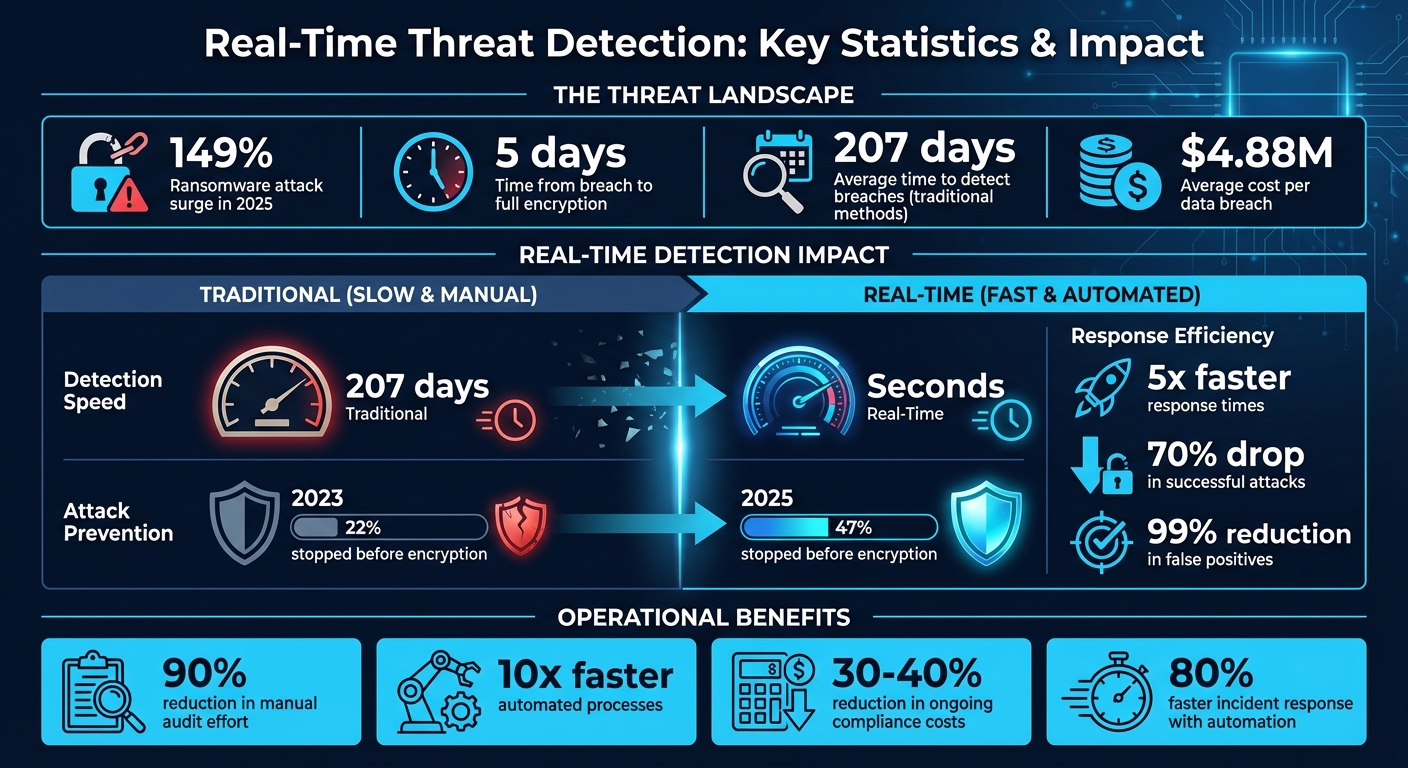
Real-Time Threat Detection Impact: Key Statistics and Benefits
Built for Speed: Real-Time Cloud Threat Detection
sbb-itb-e3aed85
What Is Real-Time Threat Detection?
Real-time threat detection takes cybersecurity to the next level by focusing on continuous monitoring of systems, networks, and user activities. This approach allows organizations to identify and respond to cyber threats as they happen, rather than relying on periodic scans that may miss critical issues. By analyzing network traffic, system logs, and user behavior in real time, these systems can stop attackers in their tracks before they cause serious harm.
Today’s real-time systems often use AI to handle massive data streams. These tools learn what "normal" behavior looks like for users, devices, and applications. When something unusual happens - like a service account suddenly downloading a large amount of sensitive data - these systems can flag it within seconds. This ability to detect and act on new, unexpected threats gives them a major edge over traditional methods.
Core Principles
Real-time threat detection is built around three key elements: continuous monitoring, anomaly detection, and automated response. Together, these components allow for instant action against emerging threats.
- Continuous monitoring ensures full visibility across network traffic, cloud services, and SaaS applications. By collecting live data from endpoints, API event streams, and user sessions, it eliminates blind spots that attackers might exploit. Nothing goes unnoticed.
- Anomaly detection creates a baseline for normal behavior, making it easier to spot unusual activity. For instance, if an account that typically logs in during business hours suddenly accesses the system from another country at 3:00 AM and begins moving data, this would trigger an alert. Statistical models help identify these deviations from the norm.
- Automated response allows systems to act immediately when a credible threat is detected. Pre-set actions, such as isolating compromised devices, revoking access tokens, or blocking suspicious IP addresses, can be executed without waiting for human intervention. A great example of this comes from May 2024, when the Fog ransomware strain appeared. Darktrace’s AI quickly isolated affected devices and blocked suspicious connections, stopping the attack before it could cause major damage.
How It Works
Real-time threat detection operates in four stages: data collection, AI-powered analysis, decision-making, and response execution.
- Data collection gathers live data from various sources, including endpoints, network sensors (e.g., Deep Packet Inspection tools), cloud logs, and SaaS platforms like Google Workspace or Microsoft 365. All this information is funneled into a centralized data lake for analysis.
- AI-powered analysis standardizes the data and uses behavioral analytics to separate harmless anomalies from real threats. By combining multiple low-confidence signals - like an unusual login followed by a large file download - into a high-confidence alert, these systems can cut false positives by up to 99%.
- Decision-making evaluates the severity of a threat. Low-confidence events are logged for further review, medium-confidence alerts might trigger additional authentication steps, and high-confidence alerts lead to immediate containment actions.
- Response execution turns decisions into swift action. Automated playbooks can terminate sessions, lock accounts, reroute traffic through inspection proxies, or quarantine infected systems. This entire process - from detection to containment - can often be completed in under a minute.
"Real-time threat intelligence means continuous monitoring with automated analysis that flags anomalies as they occur and triggers response protocols without human intervention in the critical path."
- Sergiy Balynsky, VP of Engineering, Spin.AI
This streamlined process ensures threats are addressed rapidly, setting the stage for the detailed threat response strategies discussed in the following sections.
Key Benefits of Real-Time Threat Detection
Better Security
Real-time threat detection has transformed how quickly organizations can identify and respond to cyber threats, reducing detection times from an average of 207 days to just seconds. This is especially important as ransomware attacks now escalate from initial entry to full encryption in only five days. By 2025, the percentage of ransomware attacks stopped before encryption is expected to climb from 22% in 2023 to 47%, thanks to the adoption of real-time security measures.
These systems focus on identifying unusual behaviors, enabling them to catch threats that traditional tools often miss - such as fileless attacks, compromised credentials, and AI-driven social engineering. For example, if a finance account attempts to access HR systems at 2:00 AM, real-time detection can trigger automated responses like revoking OAuth tokens, suspending accounts, or isolating devices. This happens before sensitive data is stolen or encrypted.
Organizations leveraging real-time detection report a 70% drop in successful attacks and respond to incidents five times faster. Additionally, these systems address the "SaaS Security Gap", where nearly 90% of enterprise applications remain unmanaged by traditional security tools.
"The organizations winning this fight aren't the ones with the best recovery plans. They're the ones who see the attack forming and kill it before encryption starts." - Sergiy Balynsky, VP of Engineering, Spin.AI
Cost and Time Savings
Besides improving security, real-time detection significantly reduces costs and operational burdens.
The average data breach costs $4.88 million. By stopping attacks within the critical five-day window, real-time detection can prevent these hefty expenses. For ransomware recovery alone, costs range between $1.8 million and $5 million per incident, making prevention far cheaper than remediation.
AI-powered platforms play a key role by cutting false positives by up to 99%, allowing security teams to focus only on genuine threats. Dror Hevlin, CISO at Reco, highlighted this advantage:
"Reco's context-based security solution enabled our team to filter out up to 99% of false positives, allowing my team to respond more effectively to real threats"
Automation also speeds up processes, completing tasks like log reviews, patch deployments, and incident investigations 10 times faster. Managed Detection and Response (MDR) services provide 24/7 coverage without the high costs of building an in-house Security Operations Center (SOC), making advanced protection more accessible to smaller organizations. Self-healing technologies further reduce incident resolution times from hours to minutes.
Compliance and Risk Management
Real-time detection doesn’t just enhance security - it also simplifies compliance and mitigates risks, turning traditionally time-consuming processes into automated workflows.
For instance, organizations undergoing HIPAA audits must respond within 10 business days. Real-time systems provide instant access to historical data and automate evidence collection, eliminating the need for months of manual log reconstruction. Automated compliance workflows can cut audit preparation time by up to 90% and reduce ongoing operational costs by 30-40%.
With enterprises using over 500 SaaS applications - and 90% of them unmanaged - real-time monitoring identifies "Shadow IT" risks like unauthorized OAuth grants, API tokens, and service accounts that bypass SSO and MFA. By 2026, this capability will extend to monitoring "Shadow AI", identifying when sensitive data is accessed by unauthorized AI tools or large language models.
These systems also map configurations to frameworks like NIST, GDPR, and SOC2, immediately flagging compliance issues. For example, GDPR requires tracking data movement across regions, while PCI-DSS enforces encryption for cloud storage.
"Compliance becomes a forcing function that clarifies market need and accelerates adoption of better security practices, not a constraint that teams work around." - Davit Asatryan, VP of Product at Spin.AI
Top Tools for Real-Time Threat Detection
Leading Tools Overview
The market offers a variety of platforms designed to address different types of threats. Darktrace takes a unique approach with its Self-Learning AI, which focuses on modeling normal behavior rather than relying only on known attack databases. This makes it highly effective at identifying new and AI-driven threats.
Microsoft Sentinel provides a cloud-native SIEM solution that integrates seamlessly with Azure and Microsoft 365. Its Security Copilot feature leverages generative AI to speed up incident investigations, resulting in 44% lower costs and a 79% reduction in false positives when compared to traditional SIEM solutions.
SentinelOne's Singularity platform delivers autonomous, machine-speed protection. Named a Leader in Gartner’s Magic Quadrant for Endpoint Protection Platforms for five consecutive years (2021–2025), it focuses on self-driving security across endpoints, cloud, and identity. According to Friedrich Wetschnig, CISO at Flex:
"We chose SentinelOne because of the protection. We believe out of the independent testing that SentinelOne is doing the best job in the market."
Elastic Security offers a combination of SIEM and XDR built on an open-source foundation. It uses AI to detect attacks and features a usage-based pricing model instead of charging per endpoint.
Palo Alto Networks' Cortex XDR achieved a 100% detection rate with no delays during MITRE ATT&CK Enterprise Evaluations Round 6. By integrating data from network, endpoint, and cloud sources, it ensures high accuracy in threat detection.
Detecto enhances automation with six specialized AI agents, including Flint for triage and Talon for containment. It also supports a "Bring Your Own Model" (BYOM) approach, allowing organizations to tailor the platform to their specific needs.
Cisco XDR employs agentic AI for threat verification and automated remediation. Robert Reading, Enterprise Network Architect at Elon University, shared:
"Cisco XDR correlates all the data in one place, giving me a comprehensive view of incidents. I can stop any threat in its tracks with just a few clicks."
Each of these tools provides critical capabilities for detecting and responding to threats in real time, ensuring organizations can act swiftly against emerging risks.
Tool Comparison
Selecting the right tool depends on factors like infrastructure, team size, and budget. Here's a quick comparison of these platforms based on their key features:
| Tool | Primary AI Feature | Deployment Focus | Unique Selling Point | Pricing Model |
|---|---|---|---|---|
| Darktrace | Self-Learning AI | Multi-domain (OT/IT/Cloud) | Behavioral modeling tailored to businesses | Enterprise-scale |
| Microsoft Sentinel | Security Copilot (GenAI) | Cloud-native SIEM | Graph-powered visibility & data lake | Data Volume/Ingestion |
| SentinelOne | Autonomous AI Agents | Endpoint & Cloud | Real-time, self-driving response | Per-endpoint/Tiered |
| Elastic Security | AI-driven Attack Discovery | Open-source XDR/SIEM | No per-endpoint fees | Usage-based |
| Cortex XDR | AI-driven Analytics | Unified SOC | 100% MITRE detection rate | Per-endpoint/Module |
| Detecto | 6 Specialized AI Agents | Autonomous SOC | BYOM flexibility | Per-Task Model Routing |
| Cisco XDR | Agentic AI | Network-led Defense | One-click threat containment | Tiered (Essentials/Advantage/Premier) |
| Sophos XDR | AI Assistant | Open Platform | Automated ransomware rollback | Commercial Subscription |
A special mention goes to Stellar Cyber Open XDR, which is particularly well-suited for mid-market organizations. It combines SIEM, NDR, and UEBA under a single license and uses Multi-Layer AI™ to correlate events across the entire attack surface. Organizations using this tool report an 88% reduction in false positives and a 20x improvement in detection speed. The University of Zurich’s Central IT Department noted:
"Stellar Cyber reduced our analysis expenses and enabled us to kill threats far more quickly."
For those looking to explore these tools further, the All SaaS Software Directory offers a detailed resource for comparing security platforms and other SaaS solutions across various industries, including software development, healthcare, and enterprise infrastructure.
Implementation Strategies
Integration with Existing Security Systems
Start by creating a detailed inventory of your servers, endpoints, network devices, cloud services, and SaaS applications. This step helps pinpoint critical data sources and uncover any blind spots before introducing new connections. Consolidate logs, alerts, and flow records into a single, unified data lake to break down silos across endpoints, cloud platforms, and SaaS environments.
Modern SIEM tools simplify this process by integrating API-based sources, often allowing setup in under 10 minutes. To streamline operations, align this system with existing SIEM, IDS, and SOAR platforms. Centralizing log aggregation and normalization not only improves efficiency but can also reduce correlation errors by up to 40%, significantly boosting detection accuracy.
Security Orchestration, Automation, and Response (SOAR) tools play a crucial role in coordinating actions across different platforms, enabling automated response playbooks to trigger upon detection. Mapping these detections to frameworks like MITRE ATT&CK offers analysts a clear view of the attack's stage and intent. This interconnected approach turns isolated tools into a seamless defense network.
Once integration is complete, a gradual roll-out ensures the system remains stable and performs effectively.
Phased Deployment
Begin with a pilot program that covers 10% to 20% of endpoints in a "detect-only" mode. This allows you to validate alerts and gather telemetry without causing disruptions to business operations. Use this phase to fine-tune thresholds and reprioritize rules before scaling up to the entire system. Focus on critical assets, such as authentication systems and financial databases, to simplify the implementation process.
Set thresholds based on the criticality of assets and the severity of threats to minimize alert fatigue. Security Operations Centers (SOCs) often face overwhelming volumes of alerts - ranging from 24,000 to 134,000 daily - yet only 0.01% represent genuine attacks. Risk-based alerting helps cut through this noise, ensuring attention is directed where it matters most.
Once performance metrics are validated, expand coverage incrementally to ensure a smooth transition.
Maintenance and Updates
Ongoing maintenance is essential for adapting to evolving threats. Regularly review false positives, test playbooks, and conduct tabletop exercises to refine detection logic. AI-driven systems should continuously update their detection models using new behavioral data and outcomes, enhancing their accuracy over time. As Brandon, a Security Researcher at Panther, explains:
"Real-time threat detection is the evolution of traditional threat detection that utilizes best-in-class modern security tools to analyze potential threats instantly."
Incorporate threat intelligence feeds from sources like CISA alerts and FBI notices to automatically flag known malicious indicators. Monitor how data moves across regions and environments, particularly as it enters AI pipelines, to identify risky flows. Regular audits of AI activity against an approved list of tools and integrations help detect unauthorized data connections.
Automated response playbooks can dramatically reduce incident response times - by as much as 80%. Document high-frequency scenarios, such as credential stuffing and malware beaconing, as version-controlled playbooks with clear triggers and rollback steps. Ensure that EDR agent updates and OS patches are synchronized because missing a critical OS patch can compromise the effectiveness of detection systems.
Conclusion
Cybersecurity is evolving rapidly. In 2023, ransomware attacks surged by 70% worldwide compared to the previous year, and enterprises now juggle over 500 SaaS applications on average. With these challenges, traditional detection methods are struggling to keep up, leaving businesses more vulnerable to attacks.
Real-time threat detection offers a solution by narrowing the window between an attack and the response. Instead of relying on outdated, signature-based tools, companies can adopt proactive behavioral analytics to spot anomalies - like suspicious logins or unexpected data transfers - as they happen, not hours or days later.
To implement real-time detection effectively, businesses need to centralize their telemetry, automate responses to counter fast-moving threats, and establish behavioral baselines. Team Cloud4C highlights the importance of this approach:
"Real-time threat detection and response remain not just a security feature - it's a business imperative."
Once these strategies are in place, the next step is choosing the right tools. Resources like the All SaaS Software Directory, curated by John Rush, can help businesses explore security solutions, compare integration options, and review compliance certifications such as SOC2 and GDPR.
With cybercrime damages expected to hit $13.82 trillion globally by 2028, adopting tools that detect, contain, and neutralize threats in seconds is no longer optional. It's essential for safeguarding your business, maintaining compliance, and staying ahead of increasingly sophisticated cyber threats.
FAQs
What’s the fastest way to start real-time detection without breaking production?
The fastest way to set up real-time threat detection without interrupting production is by utilizing pre-configured tools and automated setups. Options like cloud SIEMs with built-in rules, centralized monitoring dashboards, and AI-driven systems allow for quick deployment. Prioritize connecting data sources such as application logs, firewalls, and cloud provider systems to ensure a smooth setup and instant threat detection - all without disrupting current operations.
How can I reduce false positives without missing real attacks?
To effectively minimize false positives while still identifying real threats, it's crucial to combine detection tuning, behavioral baselines, and threat intelligence. Regularly reviewing and refining alert rules based on feedback is another key step. Leveraging AI-powered automation alongside systematic detection engineering - such as thorough testing and ongoing improvements - can dramatically reduce noise. This approach helps organizations bring false positives down to below 10%, all while ensuring genuine threats are accurately detected.
Which logs and telemetry sources are most important for real-time threat detection?
When it comes to spotting threats in real time, certain telemetry sources are absolutely essential. These include logs from endpoints, network devices, cloud services, identity providers, and applications. Each provides critical data points like authentication events, network traffic, access logs, and cloud activity.
Some sources stand out more than others. For example, endpoint detection and response (EDR) logs and network logs (like those from firewalls or intrusion detection systems) are particularly useful. Additionally, telemetry from identity systems and threat intelligence feeds adds vital context, making it easier to pinpoint unusual or suspicious behavior. These layers of data work together to create a clearer picture of potential threats.