Tiered pricing models help SaaS companies cater to diverse customer needs by offering multiple subscription options, typically 2–4 tiers. Each tier provides different features, usage limits, or support levels, enabling businesses to target various market segments - from freelancers to large enterprises. For example, a startup might pay $45/month for basic features, while an enterprise could spend $3,600/month for advanced tools and premium support.
This model drives predictable revenue, encourages upgrades, and aligns pricing with customer value. Common SaaS subscription models include:
- Feature-Based: Pricing depends on feature sets (e.g., HubSpot's tiered tools).
- Usage-Based: Charges based on consumption (e.g., Twilio's pay-per-use).
- User-Based: Charges per user (e.g., Slack's per-seat pricing).
Most SaaS companies use 3 tiers ("Good-Better-Best") to balance simplicity and revenue potential. Larger businesses may add a 4th tier for enterprise clients. Hybrid models combining multiple structures are also popular, offering flexibility for both customers and providers.
Key Takeaways:
- 2 Tiers: Simple but limits revenue opportunities.
- 3 Tiers: Ideal for growing SaaS companies; leverages the "decoy effect."
- 4+ Tiers: Maximizes revenue but increases complexity.
To succeed, align tiers with customer needs, regularly review pricing, and test strategies to optimize conversions and retention.
SaaS Pricing Models Explained (Perfect Tiered Pricing and the Subscription Based Business Model)
sbb-itb-e3aed85
Types of SaaS Tiered Pricing Structures
SaaS companies typically design their pricing tiers around three main models: feature-based, usage-based, and user-based pricing. Each model ties the price to a specific value driver, making it easier for businesses to align costs with customer needs.
Feature-Based Tiers
In this model, plans are differentiated by the features they offer rather than the number of users or resources consumed. A basic plan might include essential tools, while higher tiers unlock advanced functionalities like automation, reporting, or integrations. This setup works well for products where customers can clearly recognize the added value of premium features.
Take HubSpot, for example. Their Marketing Hub starts at $45/month for a Starter plan offering basic tools for 1,000 contacts. The Professional tier costs $800/month and includes advanced automation and reporting, while the Enterprise plan, priced at $3,600/month, provides the full suite of capabilities. This structure ensures customers pay for the features they need, but it can be tricky to decide which features to include in each tier. Moreover, customers might hesitate to upgrade if the additional features don’t align with their specific needs.
Now, let’s look at a pricing model linked directly to customer consumption.
Usage-Based Tiers
Usage-based pricing charges customers based on how much they use the product. Metrics like API calls, storage space, emails sent, or data processed often determine the cost. This "pay-as-you-go" model is especially popular for infrastructure and developer tools. For instance, Twilio charges $0.0075 per SMS message and $0.0140 per minute for voice calls.
This approach is appealing because it feels fair - customers only pay for what they actually use. It also lowers the barrier to entry and naturally scales with business growth. However, it can lead to unpredictable revenue for the company and "bill shock" for customers if their usage spikes unexpectedly.
Finally, let’s explore a model designed for team-oriented tools.
User-Based Tiers
User-based pricing charges a fixed fee per user account, making it a straightforward choice for B2B collaboration tools. Slack, for example, offers a Pro plan at $7.25 per user per month and a Business+ plan at $12.50 per user per month.
This model provides predictable revenue as pricing scales with the size of the customer’s team, making it easier for businesses to forecast growth and for customers to plan budgets. However, it can discourage product adoption if companies limit the number of users to save costs. There’s also the potential issue of unauthorized account sharing.
| Pricing Model | Best For | Primary Metric | Revenue Predictability |
|---|---|---|---|
| Feature-Based | Modular products (e.g., QuickBooks) | Functionality/Tools | High |
| Usage-Based | Infrastructure/APIs (e.g., AWS, Twilio) | Consumption (API calls, GB) | Low |
| User-Based | Collaboration tools (e.g., Slack, Zoom) | Number of Seats | Very High |
Hybrid models are also an option, combining elements from multiple pricing structures. For instance, a company might charge a base per-user fee while adding usage-based overages for features like API calls or extra storage. This approach offers flexibility, catering to a broader range of customer needs.
How to Choose the Right Number of Tiers
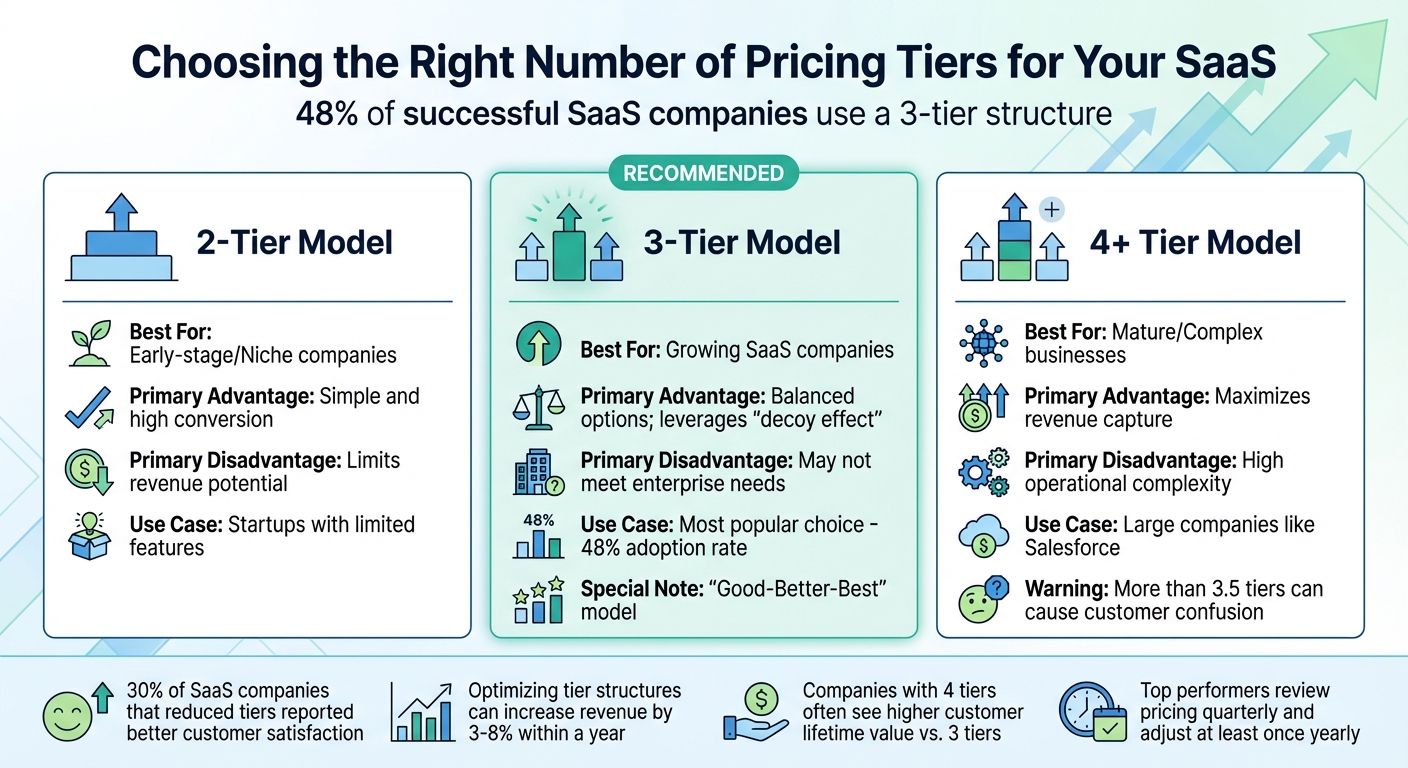
SaaS Tiered Pricing Models Comparison: 2, 3, and 4+ Tiers
When deciding on the number of pricing tiers, consider how your customer base is segmented and the complexity of your product. Different groups of customers have varying levels of willingness to pay, and your tiers should reflect those differences.
"Your pricing should reflect the natural segmentation that exists in your customer base".
For early-stage startups, starting with two tiers - basic and premium - helps minimize decision fatigue. Interestingly, 48% of successful SaaS companies use a three-tier structure. The "Good-Better-Best" model is particularly effective, as it leverages the decoy effect to highlight the middle option as the most appealing. This approach aligns with the principles of tiered pricing discussed earlier.
Here’s a closer look at how different models fit various stages of growth and market needs.
2-Tier Models
For startups in the early stages with a limited set of features, a two-tier system works well. It keeps things simple for customers and reduces the likelihood of overwhelming them with too many options. However, as the business grows, this simplicity might limit revenue opportunities.
3-Tier Models
As products evolve and cater to a broader audience, adopting three tiers strikes a solid balance. This model captures the needs of diverse customer segments while avoiding the complexity of too many choices. It also takes advantage of the "decoy effect", where the middle option often becomes the most popular.
4+ Tier Models
Larger companies, such as Salesforce, often use four tiers (e.g., Essentials, Professional, Enterprise, Unlimited) to serve a wide range of customers, from small startups to global corporations . While this approach maximizes revenue potential, it does come with added operational challenges, such as creating distinct marketing materials, onboarding processes, and support systems for each tier.
Interestingly, 30% of SaaS companies that reduced their number of tiers reported better customer satisfaction and lower costs. Additionally, optimizing tier structures has been shown to increase revenue by 3–8% within a year. Companies that stick with four tiers often see higher customer lifetime value compared to those with three.
That said, offering more than 3.5 tiers can lead to customer confusion and abandoned purchases if not carefully managed. Top SaaS performers regularly review their pricing strategies - quarterly, in many cases - and make adjustments at least once a year to stay competitive.
Here’s a quick summary of tier options, along with their pros and cons:
| Number of Tiers | Best For | Primary Advantage | Primary Disadvantage |
|---|---|---|---|
| 2 Tiers | Early-stage/Niche | Simple and high conversion | Limits revenue potential |
| 3 Tiers | Growing SaaS | Balanced options; "decoy effect" | May not meet enterprise needs |
| 4+ Tiers | Mature/Complex | Maximizes revenue capture | High operational complexity |
SaaS Companies Using Tiered Pricing Successfully
These examples showcase how companies tailor tiered pricing strategies to align with customer needs and business growth.
Zendesk
Zendesk structures its pricing around per-feature vs. per-user models by focusing on feature sets rather than usage limits, offering three main tiers: Team at $49 per agent per month, Growth at $79, and Professional at $99. Each tier adds more advanced customer support tools. For example, the Team plan focuses on basic ticketing, while Professional includes advanced analytics and automation. This approach ensures that businesses of all sizes, from startups to larger enterprises, can find a plan that fits their evolving support needs.
Now let’s see how Mailchimp combines usage and feature-based pricing in its model.
Mailchimp
Mailchimp takes a hybrid approach by blending usage limits with feature upgrades. The Free plan includes 1,000 monthly email sends, while Essentials starts at $13 per month for 5,000 sends and includes A/B testing. The Standard plan, priced at $20 per month, offers 6,000 sends alongside personalization tools, and Premium begins at $350 per month for 150,000+ sends, adding priority support. This model encourages upgrades as businesses grow their email campaigns. By including the Standard plan, Mailchimp makes the Premium tier even more attractive for users scaling their marketing efforts .
"A tiered pricing model allows businesses to cater to all customers, from budget-conscious consumers to those willing to pay for more premium features." - Mailchimp
Slack, on the other hand, uses a per-user pricing model with clear upgrade triggers.
Slack
Slack combines per-user pricing with feature restrictions to drive adoption. The Free plan costs $0 but limits searchable message history to 90 days and allows only 10 app integrations. The Pro plan, at $7.25 per user per month (billed annually), removes these limits and adds features like group huddles. For $12.50 per user per month, the Business+ tier includes advanced options like SAML SSO and a 99.99% uptime SLA, targeting larger organizations with stricter security needs. Finally, Enterprise Grid offers custom pricing, HIPAA compliance, and unlimited workspaces. Slack’s strategy of offering 80% of daily value for free while gating the remaining 20% behind paid tiers ensures that active teams quickly reach the free plan’s limits, encouraging upgrades when full functionality becomes essential.
Advantages and Disadvantages of Tiered Pricing
Tiered pricing is a strategy designed to align pricing with customers' willingness to pay, offering distinct benefits while posing some challenges. It allows companies to cater to a wide range of customers, from budget-conscious startups to enterprise clients, by offering different pricing levels. This approach not only maximizes revenue but also encourages customers to upgrade as their needs evolve, boosting the average revenue per user.
Another benefit of tiered pricing is its flexibility. Customers experiencing budget constraints can downgrade to a lower tier instead of canceling their subscription entirely. This keeps them within the company's ecosystem, improving retention and opening the door for future upgrades.
However, this model isn't without its downsides. Managing multiple pricing tiers can create operational challenges. Businesses must track varying customer entitlements, maintain different service levels, and handle complex billing systems. There’s also the risk of pricing cannibalization - if tiers aren’t clearly differentiated, high-value customers may opt for lower-priced plans that still meet their needs, leading to revenue loss.
"If your tiered pricing model is not designed with care, lower-priced tiers can cannibalize sales from higher-priced ones." - Stripe
Another challenge is the risk of overwhelming customers with too many options. When faced with more than four tiers or unclear descriptions, customers may either choose the cheapest plan or abandon the decision altogether. Interestingly, only 39% of SaaS companies use a value-based pricing approach, while 27% rely on internal judgment, and 24% mimic competitors.
These factors highlight the importance of designing a clear and effective tier structure.
Comparison Table
| Category | Advantages | Disadvantages |
|---|---|---|
| Business Impact | Maximizes revenue potential; provides predictable recurring revenue; enables market segmentation | Operational complexity; risk of cannibalizing higher tiers; ongoing maintenance overhead |
| Customer Experience | Offers flexibility and scalability; lowers entry barriers; aligns value with price | Potential for decision fatigue; confusion if tiers are poorly defined; risk of paying for unused features |
| Growth Strategy | Creates natural upgrade paths; improves retention through downgrades; offers insights into customer preferences | Difficult to balance pricing optimally; risk of brand damage if premium tiers appear overpriced |
How to Implement a Tiered Pricing Strategy
Refining your tiered pricing strategy involves a structured approach and strategic planning tools: start with your premium offering, align features to perceived value, and constantly test and adjust to meet market demands. Let’s break it down.
Price Tiers from Top to Bottom
Begin by defining your Enterprise or Premium tier - this is where your product delivers its maximum value. Include everything a large organization might need, like unlimited usage, advanced security, priority support, or integrations. Once your premium tier is set, work backward by removing less critical features to create mid-tier and entry-level plans.
This "top-down" method helps ensure your product isn’t undervalued. Use clear pricing ratios and open-source billing tools to make comparisons simple for customers: for example, set your Starter plan at 1x, Growth plan at 2–3x, and Enterprise plan at 4–5x.
Here’s a tip: list your most expensive tier first on your pricing page. Why? Anchoring psychology. Stripe explains:
"The first number customers see could leave a lasting impression. For example, if the pricing page lists the $300/month plan before the $100/month plan, $100 feels more reasonable".
This approach not only sets expectations but also helps customers better understand the value of each tier.
Match Features to Value
Each tier should represent a clear value progression, encouraging upgrades without overwhelming users. Avoid restricting fundamental features customers expect at all levels. Instead, reserve advanced tools - like detailed analytics, single sign-on (SSO), or API access - for premium plans where they provide measurable business benefits.
Choose a value metric that grows with customer success - like active users, API calls, or contacts managed. Tie this metric to upgrade triggers so your revenue scales as customers get more out of your product. For example, if your Starter plan supports 1,000 contacts and your Growth plan supports 10,000, customers naturally hit a limit that nudges them to upgrade.
Interestingly, only 39% of SaaS companies use value-based pricing today, while others rely on intuition (27%) or simply copy competitors (24%). Setting upgrade thresholds and using descriptive tier names like "Startup", "Professional", and "Enterprise" can help customers easily identify the plan that fits their business stage.
Test and Optimize Your Pricing
Even after aligning your pricing tiers, regular testing is critical to ensure they hit revenue and growth targets. Pricing isn’t a set-it-and-forget-it task - it’s an ongoing process. In fact, companies that adjusted their pricing in 2022 saw a median 14% increase in net dollar retention.
Use A/B testing to experiment with price points and bundles, and track metrics like conversion rates, upgrades, and ARPU (average revenue per user). For businesses with lower traffic or enterprise-focused sales, consider cohort testing (applying new pricing to specific groups of new customers) or shadow testing (quoting new pricing selectively in pitches) to gauge reactions.
Don’t stop at quantitative data - customer interviews and surveys can provide valuable insights. Models like Van Westendorp’s Price Sensitivity Meter can help you discover acceptable price ranges and gauge price sensitivity before rolling out changes. Keep an eye on metrics like Net Revenue Retention (NRR) and upgrade/downgrade patterns to spot underperforming tiers.
If you decide to raise prices, consider "grandfathering" existing customers on their current plans for a limited time. This can help maintain goodwill and reduce churn.
Best Practices for Tiered Pricing
Once your pricing structure is in place, there are proven strategies to help boost conversions, grow revenue, and keep your customers happy. Insights from thousands of SaaS companies highlight these key practices.
Use 3 Tiers as Your Default
Three tiers are often the sweet spot for SaaS businesses. This "Good-Better-Best" model provides customers with meaningful options without overwhelming them. Too many choices can lead to decision paralysis, making it harder for prospects to commit.
Each tier in this model serves a distinct purpose. The Basic plan acts as an entry point, ideal for smaller customers or those just exploring your product. The Standard plan is your main revenue driver - it’s the option you want most customers to choose. Lastly, the Premium plan serves as a price anchor, making the middle-tier pricing seem more reasonable in comparison.
This structure encourages you to focus on delivering value at each level rather than simply copying competitors' offerings.
For businesses targeting larger enterprises with more complex needs, custom enterprise pricing becomes the next logical step.
Add Custom Enterprise Pricing
While the three-tier model works for most companies, some customers require tailored solutions. Custom Enterprise pricing caters to these clients by offering features like dedicated account managers, custom integrations, advanced security options, and volume discounts. Instead of listing a fixed price, use terms like "Contact Sales" or "Custom Pricing" on your website.
This approach achieves two goals: it attracts high-value customers who might otherwise outgrow your top-tier plan, and it avoids scaring off smaller customers with intimidating enterprise-level pricing. With approximately 30,800 SaaS companies operating globally in 2024, the most successful ones understand that enterprise deals require personalized discussions, not cookie-cutter pricing.
Pro tip: Position your highest standard tier close to the starting point of custom pricing. This creates a natural progression for growing businesses, making the jump to enterprise pricing feel manageable rather than overwhelming.
Track Upgrades and Churn Rates
Creating pricing tiers is only half the battle - you also need to monitor how they perform. Keep a close eye on upgrades and churn rates to ensure your strategy is working. Tracking upgrade MRR (Monthly Recurring Revenue from customers moving to higher plans) will show whether your tiers are encouraging value-based upsells. If upgrades are rare, you might be offering too much value at lower price points.
On the flip side, monitor Gross MRR churn - aim for around 1% for enterprise companies and 2% to 2.5% for small businesses. High churn rates could mean your pricing is too aggressive or that competitors are offering better value. As Yoav Shapira, Director of Engineering at Facebook, advises:
"#1 tip for pricing strategy is to treat it as an experiment".
Despite this, over 40% of companies never test their pricing strategies, and 55% fail to research what their customers are willing to pay. Use A/B testing to try out different tier configurations, and keep an eye on your LTV/CAC ratio (Customer Lifetime Value to Customer Acquisition Cost). A ratio above 1 is crucial for profitability. If you decide to raise prices, consider grandfathering existing customers into their current rates to avoid a spike in churn.
Conclusion
Getting tiered pricing right is an ongoing process that balances customer value with your business goals. Successful SaaS companies focus on pricing based on the value they deliver to customers rather than simply covering costs. Interestingly, only a small percentage of companies fully embrace value-based pricing - 27% rely on their own intuition, while 24% base their prices on competitors' models.
To keep things simple for your customers, limit your pricing options to 3–4 tiers. Each tier should cater to a specific buyer persona, offering clear upgrade paths as customer needs grow. Keep a close eye on metrics like upgrade MRR, churn rates, and the LTV/CAC ratio to ensure your pricing stays profitable and competitive. Even small improvements in monetization - just 1% - can result in a 12.7% boost in profit, making it four times as efficient as acquisition efforts.
Revisit your pricing strategy every six months to stay in tune with market shifts. A/B testing can help validate your assumptions, and when making adjustments, consider grandfathering existing customers to maintain their loyalty.
For inspiration, check out the All SaaS Software Directory, which highlights hundreds of SaaS products across various categories like billing, communication, and software development. Companies like Mailchimp, Slack, and HubSpot provide excellent examples of how to structure pricing tiers effectively. These examples can guide you in refining your own approach.
At its core, aligning pricing decisions with customer value is the key to building a scalable SaaS business. Stay connected to your customers, be open to adjustments as you learn, and let your pricing evolve alongside your product and market. This flexibility is what sets successful SaaS companies apart from those that struggle to grow.
FAQs
How do I pick the right value metric for my tiers?
Selecting a value metric that matches how customers perceive value is crucial. It should be measurable, scalable with usage, and tied directly to the benefits your product delivers.
Start by understanding how your customers derive value from your product. Is it the number of users (seats), the volume of API calls, the amount of storage, or access to specific features? Once you’ve pinpointed this, narrow down your options to metrics that best represent that value.
Next, evaluate each metric based on three key factors:
- Value alignment: Does the metric closely reflect the value customers receive?
- Predictability: Is the metric easy to understand and forecast for both you and your customers?
- Measurability: Can the metric be tracked accurately and consistently?
Finally, test your chosen metric with customers. Their feedback will help you confirm if it resonates and works in real-world scenarios. This approach ensures your pricing not only supports growth but also mirrors the value your product delivers.
When should I switch from 2 tiers to 3 or more tiers?
When your customer base starts to diversify, your product line expands, or you want to cater to specific market segments, consider moving to three or more pricing tiers. This approach can help simplify choices for customers, open doors for upselling, and ensure your offerings meet the unique needs of different groups.
How can I raise prices without increasing churn?
To adjust prices without driving customers away, it's crucial to align those changes with the value customers perceive. One effective approach is using tiered pricing, which provides flexible options tailored to different needs. Any price increase should be backed by clear improvements or added benefits that customers can easily recognize.
Transparent communication is key - explain the reasons behind the adjustments and how they enhance the product or service. Gradual changes, rather than abrupt hikes, can also help ease the transition. Additionally, segment your customer base to understand how different groups might respond to the changes, allowing for better planning and minimized risk.
By combining these steps with regular customer feedback, you can ensure that pricing adjustments feel justified and reflect the quality of the service being provided.