The freemium model is a popular pricing strategy for SaaS companies, offering a free basic version of software with paid premium features. It’s a powerful tool for user acquisition and growth, but it comes with challenges. Here's a quick breakdown:
- Advantages:
-
Challenges:
- Supporting free users increases costs for servers and customer support.
- Conversion rates are typically low (2–5% on average).
- Overly generous free tiers can discourage upgrades.
- Scalability requires low marginal costs and a large user base.
Freemium works best for products with minimal costs per user and strong network effects. However, it may strain resources if not managed carefully. Other pricing models, like subscription-only or usage-based, might be better for niche or high-support products, similar to the best SaaS software solutions for businesses that prioritize specific operational needs.
Key takeaway: Freemium can fuel growth but requires a clear strategy to balance free user support and revenue generation.
1. Freemium Model for SaaS
User Acquisition
The freemium model eliminates upfront costs, making it easy for users to try a product without financial commitment. This strategy encourages rapid user adoption, often fueled by word-of-mouth and referrals. Free users can even become unofficial marketers when the product includes visible branding elements.
Take Tally, a form-building startup, as an example. By January 2025, they hit $150,000 in monthly recurring revenue without spending on traditional marketing. How? Every free form prominently displayed a "Powered by Tally" logo, turning users into a built-in distribution channel. Similarly, Vistaprint attracted 17 million customers by offering 250 free business cards (normally $85+) and charging only $5.67 for shipping.
However, balancing quantity and quality is essential. While acquiring free users is relatively inexpensive, converting them into paying customers can cost up to five times more. Many successful freemium companies maintain a 10:1 ratio of free to paid users.
Revenue Potential
The freemium model thrives on converting a small percentage of free users into paying customers. On average, SaaS businesses see conversion rates around 5%. That small group must generate enough revenue to cover the costs of supporting the 95% of non-paying users.
To encourage upgrades, companies often restrict advanced features for free users. For instance, Slack replaced its 10,000-message limit with a 90-day message history, making upgrades more appealing to users needing long-term access. Similarly, Zoom caps free meetings at 40 minutes for up to 100 participants, nudging professional users toward paid plans.
Phil Libin, CEO of Evernote, summed it up perfectly:
"The easiest way to get 1 million people paying is to get 1 billion people using".
But there’s a catch - if the free version meets all user needs, why would anyone upgrade? A conversion rate below 5% within a year may signal that the free plan is too generous. While conversions drive revenue, scaling operations to meet demand without breaking the bank is equally critical.
Operational Costs
Free users aren’t truly "free." They consume resources like server bandwidth, storage, and customer support. If growth outpaces revenue, it can strain infrastructure.
Baremetrics experienced this firsthand. Rapid growth in free users caused significant performance issues, as paying customers were outnumbered. Reflecting on the strain, founder Josh Pigford stated:
"Our free plan was causing our business to slowly implode".
To make freemium financially viable, using efficient billing and subscription management tools is key, as the cost of serving additional users must be minimal - ideally as low as a single database entry. Products that need intensive onboarding or sales support may find scaling through freemium particularly challenging. Another hurdle: free users often demand more from support teams than paying customers, pulling resources away from improving the product and retaining premium users.
Scalability
For freemium to succeed long-term, scalability is non-negotiable. The model works best when three conditions are met: low marginal costs, a large potential user base, and a product that users can adopt without much help. Network effects - where the product becomes more valuable as more people use it - can further amplify growth, as seen with Slack and Zoom.
Mailchimp’s co-founder, Ben Chestnut, took a cautious approach. He waited eight years to build a profitable, self-serve product before introducing a freemium tier. This allowed them to handle the high free-to-paid user ratio without overwhelming their infrastructure. On the flip side, companies that rush into freemium often face operational headaches.
Rob Walling, founder of Drip, offers a stark warning:
"Freemium is like a Samurai sword: unless you're a master at using it, you can cut your arm off".
Recent trends show SaaS giants like Slack, Asana, Airtable, and Mailchimp tightening their free tiers. These changes reflect a shift in priorities: companies are focusing more on sustainable growth and profitability rather than chasing sheer user numbers.
sbb-itb-e3aed85
2. Other SaaS Pricing Models
User Acquisition
Freemium models are great for lowering financial barriers, but there are other ways to attract users. Premium-only models require customers to pay upfront, ensuring that every lead has a clear intent to purchase. On the other hand, free trials give users full access to features for a limited time, usually between 7 and 30 days, creating a sense of urgency without committing to a forever-free option.
Freemium models tend to have acquisition costs up to 60% lower than premium-only models. However, this comes with trade-offs. Premium models focus on leads ready to buy, while freemium relies on Product-Qualified Leads (PQLs) - users who engage with the product meaningfully.
Christopher O'Donnell, SVP of Product at HubSpot, highlighted this shift:
"I would argue that freemium fell short in B2B and from its ashes rose the PQL".
Usage-based pricing models, like Twilio’s $0.0075 per SMS, remove the friction of seat-based pricing, allowing customers to start small and scale as needed. This approach works well for products where direct value delivery matters more than viral growth. Interestingly, freemium products convert customers without any sales involvement 25% more often than free trial models. These acquisition strategies directly influence how companies generate revenue, which we’ll explore next.
Revenue Potential
Each pricing model generates revenue in unique ways. For example, per-user pricing - like Slack’s $7.25/user/month Pro plan - provides predictable monthly revenue that grows with team size. In contrast, flat-rate models, such as Basecamp’s $99/month for unlimited users, offer stable revenue but risk undercharging heavy users.
Freemium faces the challenge of the "Penny Gap", the psychological hurdle of converting free users into paying customers. Premium and trial models sidestep this by setting payment expectations from the start. Usage-based pricing ties revenue to customer value, scaling automatically with consumption, though it results in more variable income.
Data reveals that 61% of technology providers convert fewer than 15% of freemium users into paying customers. Spotify, however, has achieved a 38.8% conversion rate, with 239 million paid subscribers out of 615 million total users as of early 2024. Premium models focus on immediate revenue, while tiered subscription plans - like HubSpot’s offerings ranging from $45/month to $3,600/month - capture a broad range of customer segments. These revenue strategies also influence how companies manage operational costs.
Operational Costs
Operational demands vary depending on the pricing model. Per-user and tiered models are simpler to manage, requiring less complex billing systems. Flat-rate pricing is the easiest to handle, as it involves one price for all users, but it risks heavy users consuming more resources than their fee covers.
Usage-based models, on the other hand, require advanced infrastructure to track real-time consumption, like API calls, data storage, or message volume. While this adds complexity and cost, it ensures that revenue grows with usage. Hybrid models, which combine multiple pricing strategies, are the most challenging to manage due to intricate billing requirements.
As one expert put it:
"The model works only when the cost of serving each new user is low, such as with software or digital content".
Premium and trial models avoid the strain of supporting large numbers of non-paying users. For example, Stripe’s automated billing tools helped users recover over $6.5 billion in revenue in 2024, showcasing the importance of robust infrastructure as pricing models become more sophisticated.
Scalability
Scalability depends on how well revenue and costs grow together. Usage-based models excel here, as revenue increases naturally with customer value and resource usage. Per-user pricing grows predictably with headcount but can create friction that limits adoption within organizations.
Flat-rate models struggle with scalability for high-growth customers. As customer usage grows, costs rise, but revenue stays flat. Tiered models manage scalability better by offering options for different customer segments, though they require careful oversight of features and pricing tiers.
Unlike freemium, these models don’t rely on massive user bases to succeed. Instead, they focus on generating immediate revenue, making them ideal for niche B2B products that often require higher levels of support. For specialized tools, a time-limited free trial often works better than a forever-free plan, as it avoids the operational burden of supporting users who may never convert.
The ultimate guide to FREEMIUM for SaaS & AI 💡
Pros and Cons
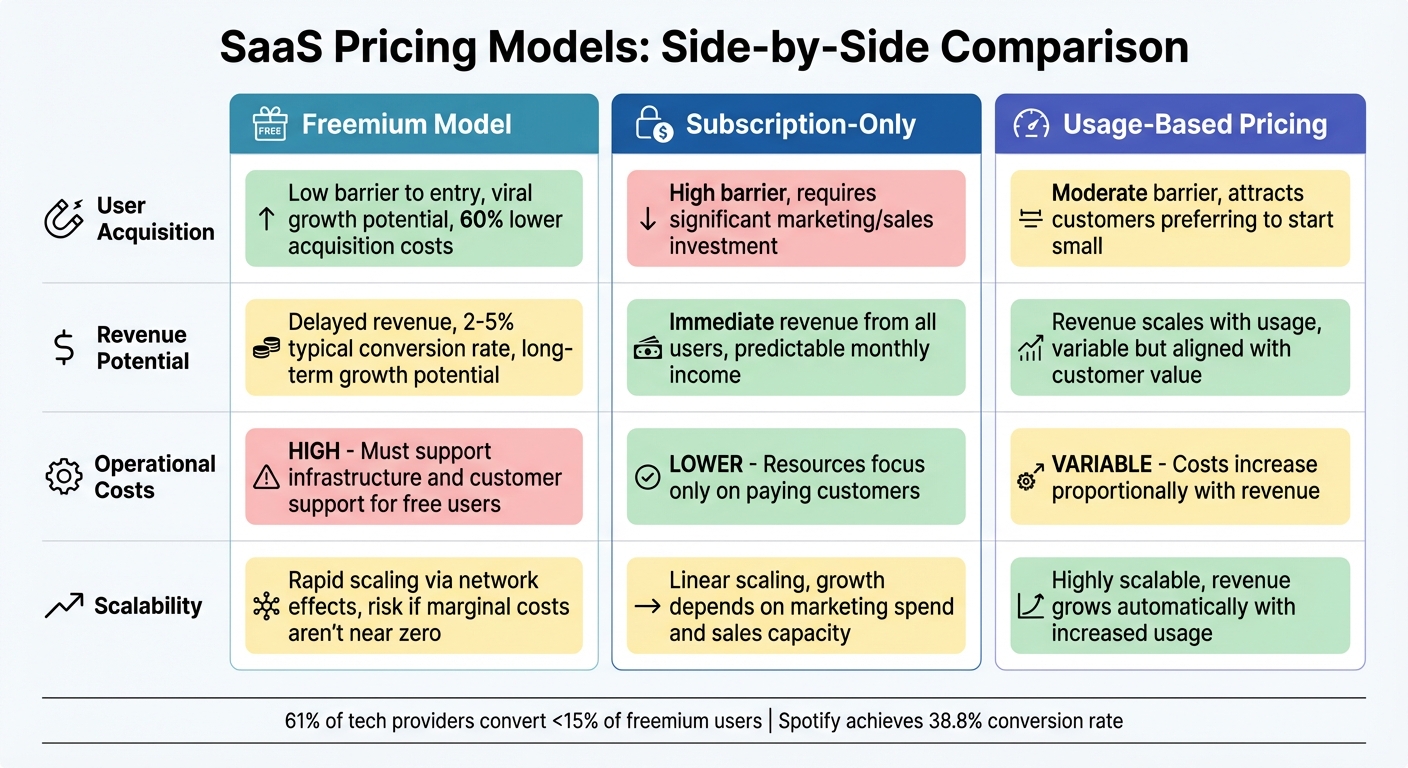
SaaS Pricing Models Comparison: Freemium vs Subscription vs Usage-Based
Let’s break down how different SaaS pricing models stack up across key business dimensions. The table below provides a side-by-side comparison of the freemium model, subscription-only pricing, and usage-based pricing:
| Dimension | Freemium Model | Subscription-Only | Usage-Based Pricing |
|---|---|---|---|
| User Acquisition | Low barrier to entry, potential for viral growth, and lower customer acquisition costs | Higher barrier; requires significant investment in marketing and sales | Moderate barrier; attracts customers who prefer starting small |
| Revenue Potential | Revenue delayed until conversion (typically 2–5%), but offers long-term growth potential | Immediate revenue from all users with predictable monthly income | Revenue scales with usage; variable but aligned with customer value |
| Operational Costs | High; must support infrastructure and provide customer support for free users | Lower; resources focus exclusively on paying customers | Variable; costs increase in proportion to revenue |
| Scalability | Rapid scaling driven by network effects, though high operational costs can be a risk if marginal costs aren’t near zero | Linear scaling; growth depends on marketing spend and sales capacity | Highly scalable; revenue grows automatically with increased usage |
The freemium model shines when it comes to acquiring users in large numbers. Statistics show that acquiring paying users costs about five times more than acquiring free users. However, this low acquisition cost comes with trade-offs. Operational costs can skyrocket because the model requires supporting a large base of non-paying users - something that can strain infrastructure and customer support teams.
Revenue generation presents another challenge for freemium. While some companies, like Spotify, achieve impressive conversion rates (up to 38.8% of free users become paying subscribers), most freemium businesses convert only a small percentage of their user base. By contrast, subscription-only models generate cash flow immediately because every user is a paying customer from the start.
Scalability in a freemium setup depends heavily on keeping marginal costs low. This model thrives when adding more free users costs next to nothing. As Phil Libin, former CEO of Evernote, famously said:
"The easiest way to get 1 million people paying is to get 1 billion people using".
Meanwhile, usage-based pricing aligns revenue directly with customer activity. This approach scales naturally as users consume more of the product, while subscription-only models grow in a more linear fashion, tied to the size of the sales and marketing efforts.
Ultimately, the right pricing strategy depends on your product’s economics and your growth priorities. If your marginal costs are minimal and your product benefits from strong network effects, the freemium model can drive massive growth. But if immediate revenue is essential or you’re targeting a niche B2B audience, subscription-only or usage-based pricing might be better suited to your goals.
Conclusion
The freemium model isn't a one-size-fits-all solution - it works well for some SaaS products but can be a poor fit for others. Its appeal lies in the low barrier to entry, but this comes with challenges like higher support costs and lower conversion rates. Freemium shines when you have a large potential user base, low marginal costs, and a product that benefits from viral growth or network effects. Companies with viral products often succeed with freemium because their offerings become more valuable as more users join, and serving additional free users doesn't significantly increase costs.
On the flip side, freemium is less effective for niche or enterprise products that demand extensive sales efforts or customer support. A free tier that's too generous can hurt your bottom line - 61% of tech providers convert fewer than 15% of freemium users into paying customers. As John Solomon from Chargebee puts it:
"A company can burn its cash reserves fast supporting a large number of non-paying customers".
Before committing to freemium, carefully assess your product's economics. Ensure the lifetime value (LTV) of paying users can offset the costs of supporting both free and paid customers. Clearly define upgrade triggers - like Zoom's 40-minute meeting cap - that nudge users toward premium tiers. Keep a close eye on engagement metrics to identify users ready to convert, and consider additional revenue streams, such as advertising, to supplement your strategy.
For products that require extensive customer education, cater to specialized markets, or have high per-user costs, other models - like subscription or usage-based pricing models - may be more effective. These alternatives generate immediate revenue and tie costs more directly to the value delivered. Ultimately, your choice should depend on your product's economics, target audience, and growth objectives - not on popular trends.
FAQs
How do I know if freemium fits my SaaS?
To figure out if the freemium model is a good fit for your SaaS, start by evaluating whether your infrastructure can manage a high volume of non-paying users without straining resources. Your product should have features that can be clearly divided into free and paid tiers, offering enough value in the free version to attract users while reserving premium features for paying customers. Also, consider whether your target audience is likely to upgrade from free to paid. Finally, balance the potential for user growth with the expenses of supporting free users to gauge if this model is practical for your business.
What should I limit in the free plan to drive upgrades?
To nudge users toward upgrading, limit access to premium features, priority customer support, or expanded usage limits within your free plan. This approach creates a clear incentive for users to pay for added value and enhanced functionality. The key is to strike a balance - offer enough in the free tier to draw users in, but make the advantages of upgrading unmistakably appealing.
How can I keep free users from overwhelming support and infrastructure?
Managing free users in a freemium SaaS model requires a careful balance of accessibility and resource management. Start by setting usage limits or feature restrictions on free accounts. This not only encourages upgrades to paid plans but also ensures that free users don't overwhelm your platform.
To handle support efficiently, rely on automated tools like FAQs, knowledge bases, or chatbots to address common questions. This keeps human support available for more complex or high-priority issues.
At the same time, keep an eye on usage patterns and scale your infrastructure gradually. This approach helps maintain a sustainable system while meeting the needs of both free and paid users. Together, these strategies can support growth without overloading your resources.