Choosing between compliance training templates and custom courses depends on your organization's needs and priorities. Templates are quick, cost-effective, and ideal for broad regulatory topics like workplace safety or anti-harassment policies. Custom courses, while more expensive and time-intensive, offer tailored content that aligns with your internal processes, workflows, and branding. The stakes are high: compliance failures can cost businesses $14.8 million annually, making the right training approach critical.
Key Takeaways:
- Templates: Affordable, fast to deploy, and cover standard regulations. Best for universal compliance needs.
- Custom Courses: Higher upfront cost but tailored to your organization's specific processes, improving engagement and retention.
- Hybrid Approach: Combine templates for general topics with custom courses for high-risk or proprietary workflows to balance cost and relevance.
Quick Comparison:
| Feature | Templates | Custom Courses |
|---|---|---|
| Cost | Low upfront; recurring fees | High upfront; no per-user fees |
| Development Time | Immediate (under 24 hours) | 8–16 weeks per module |
| Customization | Minimal (basic branding) | Fully tailored to workflows |
| Engagement | Lower (generic examples) | Higher (role-specific scenarios) |
| Scalability | Costs grow with workforce size | Cost-effective for large teams |
| Maintenance | Automatic updates included | Requires manual updates |
For many organizations, a hybrid strategy - using templates for standard needs and custom courses for specialized training - delivers the best results while managing costs effectively.
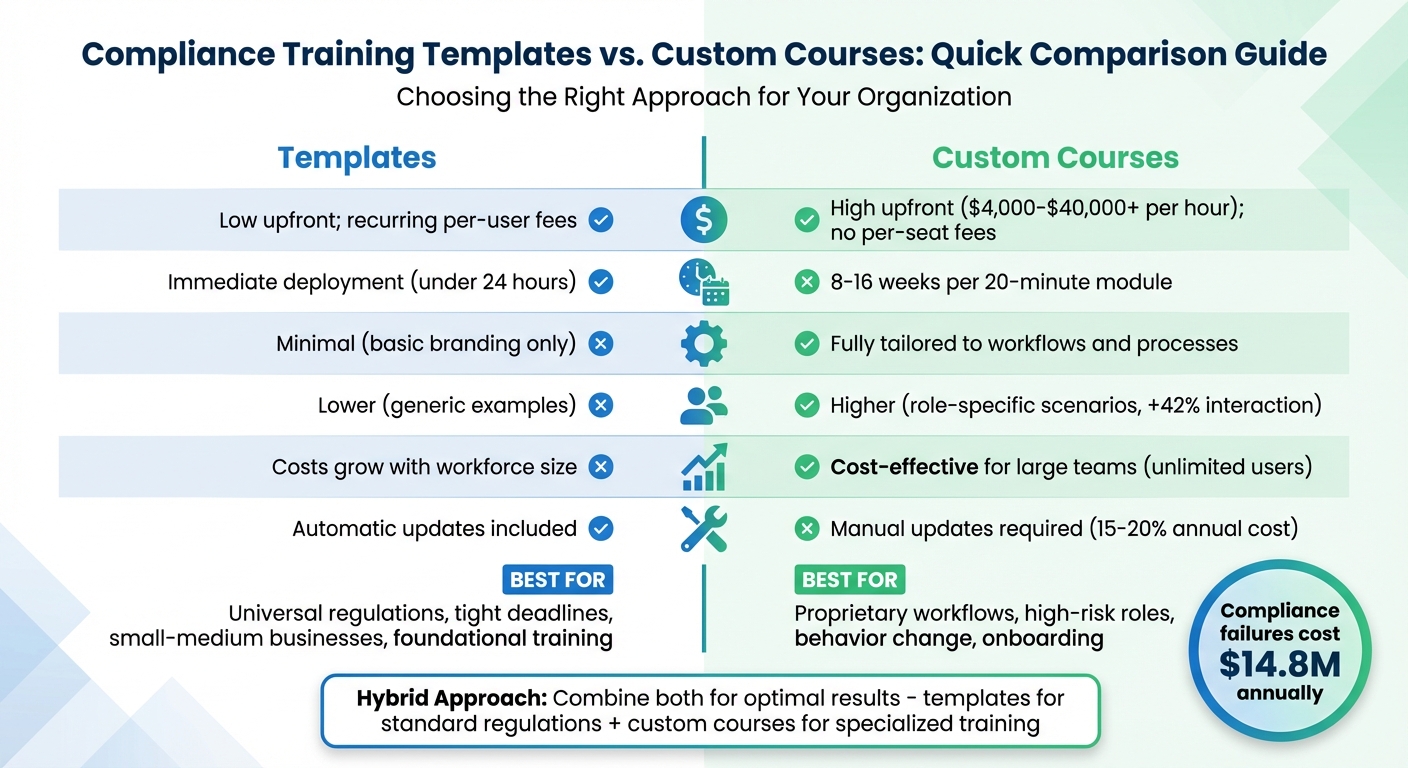
Compliance Training Templates vs Custom Courses Comparison Chart
How to create an engaging online compliance training program | FREE WEBINAR
sbb-itb-e3aed85
What Are Compliance Training Templates?
Compliance training templates are pre-built frameworks designed to deliver standardized courses on key regulatory topics like workplace safety, anti-harassment policies, and data protection. These templates are crafted to meet industry regulations and often include built-in rules to ensure compliance. For example, they might align with OSHA safety standards, HIPAA privacy rules, or GDPR requirements. Many of these templates are reviewed by legal experts and may even come pre-approved for continuing education credits.
The primary benefits? Speed and cost-efficiency. Templates can cut document creation time by 40%–60% and are often ready to deploy in under an hour. In contrast, developing custom compliance content can cost anywhere from $15,000 to $40,000 per topic. Platforms like TalentLMS, which use templates, start at just $69 per month for up to 40 users.
Features of Compliance Training Templates
These templates typically include ready-made modules covering a range of standard compliance topics. Common examples include:
- Workplace safety
- Sexual harassment prevention
- Cybersecurity awareness
- Anti-money laundering for financial services
Each module usually incorporates standardized formatting, role-based access controls, and seamless integration with learning management systems (LMS).
One standout feature is automatic updates. When regulations change, the provider updates the content, reducing the need for internal legal research. Templates also include version control and tracking, which are essential for creating audit trails that show exactly what content was delivered. Organizations using these platforms often report an 87% time savings in certification tracking.
Modern compliance templates are also designed for convenience. Many support mobile-first delivery, enabling employees - especially deskless or frontline workers - to complete training via SMS links directly on their phones. Additionally, training is increasingly offered in 5–10 minute microlearning formats to boost engagement and retention.
Strengths and Limitations of Templates
Templates are a great choice for organizations with limited budgets or tight deadlines. Their affordability and rapid deployment mean you can start training employees the same day you sign up. There's no need for IT support or specialized e-learning developers; administrators can quickly import employee lists and launch courses. Notably, teams using compliance software with templates report 95% completion rates, compared to just 67% with manual tracking methods.
That said, templates do have their limits. They are inherently less flexible, which can make it challenging to customize content. While they’re perfect for broad regulatory requirements, they may not address unique internal protocols, specific workflows, or company-specific language. Templates are best suited for universal regulations but may fall short when it comes to training employees on proprietary processes, product-specific tasks, or your organization’s mission and values.
"Compliance training templates serve as essential tools for organizations looking to fulfill legal obligations and promote a culture of integrity." – UMU
To bridge the gap, many organizations pair template-based modules for general regulations with custom content tailored to their unique needs. This hybrid approach allows for both efficiency and specificity, paving the way for a deeper dive into custom compliance courses.
What Are Custom Compliance Courses?
Custom compliance courses are designed specifically for your organization's unique needs, incorporating its processes, terminology, tools, and regulatory challenges. Unlike generic templates that provide broad industry guidelines, these courses reflect your company's values, vision, and internal procedures. The result? Employees gain practical knowledge tailored to their daily responsibilities instead of generic lessons that might not fully apply to their work environment.
The standout feature is relevance. Custom courses mirror your organization’s workflows, decision-making processes, and language. For instance, instead of presenting general HIPAA guidelines, a tailored course for a hospital could guide clinical staff through the exact steps for accessing patient records in their specific electronic health system, using the facility's own protocols and terminology.
This personalized approach yields real results. Studies show that custom training improves knowledge retention by up to 60%, and role-specific content can boost competency levels by 30% compared to generic training. Additionally, organizations using dedicated compliance platforms have seen a 78% drop in compliance violations. Given that compliance failures can cost businesses an average of $14.8 million annually in fines and legal fees, the value of tailored training is clear.
"Training only works when it's relevant. Generic content might fill a gap, but it rarely changes behavior. And behavior change is the real goal." – Girish Aithal, 4Edge IT Solutions
Characteristics of Custom Courses
Custom courses are built to align with your internal policies, procedures, and real-life scenarios. They often include branching scenarios that simulate actual decisions employees must make, helping them build confidence and practical skills. For example, a manufacturing company might create a custom safety course that walks employees through specific equipment shutdown procedures using visuals from their own production line.
Role-specific training is another essential feature. By tailoring content to different departments - like creating separate compliance modules for clinical staff and IT teams - organizations can address the unique challenges each group faces.
These courses also integrate proprietary knowledge, such as trade secrets, internal best practices, and company-specific protocols. For example, a financial services firm might develop anti-money laundering training that combines regulatory requirements with its proprietary risk assessment tools and reporting systems.
Interactive elements further enhance engagement. Features like simulations, adaptive learning paths, and even virtual reality scenarios for high-risk situations can increase learner interaction by 42%. These tools not only make training more engaging but also lead to measurable improvements in compliance adherence.
Benefits and Challenges of Customization
The biggest advantage of custom courses is their relevance. Training that uses familiar workflows and language helps employees see exactly how compliance applies to their roles. This alignment is a priority for 83% of L&D leaders who aim to connect learning outcomes with business goals.
Custom courses also strengthen legal defensibility. By addressing specific risks and tailoring content to your organization, you can demonstrate to regulators that your training goes beyond generic advice. This targeted approach provides clear evidence during audits that your compliance efforts are proactive and thorough.
Another benefit is flexibility. When regulations or internal policies change, custom courses can be updated immediately without waiting for external vendors. This ensures your training stays current and aligned with evolving business needs.
That said, customization does come with challenges. Creating custom compliance training requires a higher upfront investment and more time compared to off-the-shelf solutions. Development often takes weeks or months, involving close collaboration between subject matter experts, instructional designers, and multimedia developers. However, many organizations find the long-term benefits - like reduced repetitive training and improved productivity - worth the initial effort.
"Custom eLearning can include proprietary knowledge, trade secrets, and internal best practices, ensuring that employees receive exclusive training that cannot be replicated elsewhere." – Udutu
These unique aspects lay the groundwork for a comparison with template-based solutions in the next section.
Templates vs. Custom Courses: Direct Comparison
When it comes to compliance training, deciding between templates and custom courses boils down to your organization's needs. As mentioned earlier, these two options differ significantly in terms of speed, cost, and level of personalization. The key trade-off? Speed versus relevance. Templates can be deployed in less than 24 hours, but they lack the tailored touch of custom courses, which take 8–16 weeks to develop a 20-minute module. While templates rely on standard, generic examples, custom courses align closely with your organization's workflows and decision-making processes.
Cost Considerations
Cost structures also vary. Templates are budget-friendly upfront but come with recurring per-user fees that grow as your workforce expands. Custom courses, on the other hand, involve a higher initial investment - ranging from $4,000 to over $40,000 per finished hour depending on complexity. However, they don't have per-seat fees, making them more cost-effective for larger organizations. Over a three-year period, off-the-shelf content can end up costing 28% more than a single custom-built course of equivalent scope.
"The choice between custom eLearning solutions and off-the-shelf courses isn't really about choosing sides - it's about choosing strategy." – The Illumina Team
Comparison Table
Here’s a side-by-side breakdown of how templates and custom courses stack up:
| Factor | Compliance Training Templates | Custom Compliance Courses |
|---|---|---|
| Cost | Low upfront; recurring per-user fees | High upfront ($4,000–$40,000+ per hour); no per-seat fees |
| Development Time | Immediate; deploy in less than 24 hours | 40–400+ labor hours per finished hour; 8–16 weeks for a 20-minute module |
| Customization | Minimal (logo and color changes only) | Highly tailored to workflows, tools, and branding |
| Legal Accuracy | Vendor-maintained with automatic updates | Organization-managed; requires manual updates |
| Engagement | Lower; uses generic examples | Higher; incorporates real-world scenarios and company culture |
| Scalability | Costs grow with headcount | Unlimited users after development; cost-effective at scale |
| Implementation Effort | Minimal; upload to LMS and assign | High; requires instructional designers, SMEs, and project managers |
| Maintenance | Included in subscription fees | 15–20% of the original development cost annually |
Impact on Engagement and Retention
Engagement and retention also play a critical role. Research shows employees forget 70% of training content within 24 hours if it's not reinforced through interactive elements. Custom courses, often designed with immersive and interactive features, can boost engagement by 42% and retention by 60%. This makes them a powerful tool for organizations looking to create lasting behavioral changes.
The next section will dive into scenarios where each option is best suited to your compliance strategy.
When to Choose Templates or Custom Courses
Deciding between templates and custom courses comes down to your compliance needs, risk tolerance, and business goals. This choice directly impacts how quickly you can deploy training, how engaging it is for learners, and how well it meets regulatory requirements.
Best Use Cases for Templates
Templates shine when you need to roll out standardized regulatory training quickly. For example, regulations like HIPAA privacy rules, GDPR data protection standards, OSHA workplace safety, or sexual harassment prevention are consistent across industries and don't rely on your internal processes. In these cases, pre-made content gets the job done.
Speed is a key advantage here. If you're facing a tight regulatory deadline or need to onboard employees fast, templates can often be uploaded to your LMS and assigned in less than 24 hours. They’re also budget-friendly, making them ideal for small to medium-sized businesses. Since development costs are spread across many users, subscription fees generally range from $69 to $459 per month, depending on your team size.
Templates are also a good fit for foundational skills training that doesn’t require much customization. Think of basic Microsoft Office skills, general cybersecurity awareness, or standard workplace conduct policies - these are areas where off-the-shelf content works just fine.
"For skills development, industry compliance, or continuing education, buying off-the-shelf content is your best bet".
While templates handle standardized needs effectively, custom courses step in when training must align closely with your unique processes.
Best Use Cases for Custom Courses
Custom courses are indispensable when your training involves proprietary workflows. For instance, if your team relies on a customized CRM with specific lead-scoring rules, a proprietary ERP system, or internal reporting methods, you’ll need training tailored to your exact processes. Research even shows that role-specific custom content can improve competency gains by 30% compared to generic options.
Industries with high risks or roles requiring complex decision-making often demand custom solutions. When mistakes could lead to serious legal, financial, or safety repercussions, you need training that mirrors real-world challenges. Only custom courses with branching simulations can replicate these nuanced scenarios.
Custom training is also essential when your goal is more than just compliance. If you're aiming to drive real behavior change or build specific capabilities - not just tick a regulatory box - custom content is the better choice.
"Training only works when it's relevant. Generic content might fill a gap, but it rarely changes behavior. And behavior change is the real goal".
Onboarding and cultural training are other areas where customization excels. Teaching new hires about your company’s mission, values, and internal policies requires a personal touch. Custom courses can include photos of your actual office, interviews with leadership, and walkthroughs of proprietary tools. These elements foster a sense of connection and context that templates simply can’t replicate.
Combining Templates and Custom Courses: A Hybrid Approach
Balancing the speed of templates with the precision of custom courses, a hybrid approach offers the best of both worlds. It uses templates for broad, regulatory needs and custom modules for organization-specific workflows. Let’s explore how to create a hybrid training program that effectively divides resources between these two components.
Start by using off-the-shelf courses for general topics, then layer in custom modules to address your company's unique processes and policies. Research backs this up: personalized learning can improve retention by up to 60% and boost competency by 30%. Focus your custom development budget on high-risk areas or roles where errors carry serious consequences.
"The smartest strategies blend both, focusing on custom content where it matters most." – Girish Aithal, Author
How to Structure a Hybrid Compliance Program
The first step is conducting a gap analysis to identify where generic templates fall short in addressing your organization’s specific risks. This helps prioritize resources - templates for low-risk, general topics and custom courses for areas requiring precision.
Next, use role-based segmentation to deliver the right mix of content. For instance, while all employees might complete a template course on basic data privacy, finance or healthcare teams could benefit from custom modules tailored to their specific protocols and controls.
Think of templates as the foundation and custom modules as flexible add-ons. Instead of recreating entire courses, you can enhance templates by adding custom links, forms, or screenshots relevant to your company’s policies. Collaborative tools also allow internal experts to add specific context directly into standardized templates.
To respect employees' time, incorporate features that let experienced staff skip general content and focus on new, tailored material. This approach ensures everyone gets the training they need without unnecessary repetition.
For delivery, mix formats to suit the content. Use self-paced eLearning templates for efficiency and scale, while reserving custom virtual classrooms, role-plays, or simulations for high-risk topics that demand deeper engagement. This aligns with the trend among 83% of L&D leaders who now prioritize tying learning programs to specific business outcomes over simple "box-checking".
Finally, centralize everything. A centralized repository for both template courses and custom materials ensures all training is tracked in one place. This simplifies compliance audits and makes it easier to update materials when regulations shift - a challenge 70% of organizations face.
Here’s a quick breakdown of how to allocate training components effectively:
| Training Component | What to Use | Why It Works |
|---|---|---|
| Foundational Knowledge | Templates | Quick to deploy, ensures regulatory compliance, and often pre-accredited. |
| Internal Policies | Custom Courses | Reflects company-specific workflows and terminology. |
| High-Risk Procedures | Custom Simulations | Mimics real-world challenges, helping reduce costly mistakes. |
| General Awareness | Templates | Cost-effective and standardized for all employees. |
| Onboarding & Culture | Custom Courses | Builds connections and introduces company-specific values and leadership. |
This hybrid method keeps costs in check while ensuring training is both efficient and impactful. Templates handle the basics, while custom content addresses the details that truly drive behavioral change.
Conclusion
Deciding between compliance training templates and custom courses comes down to what aligns best with your organization's goals, risks, and resources. Templates are great for quick deployment of foundational topics like general HIPAA awareness or basic cybersecurity. On the other hand, custom courses shine when training needs to address proprietary systems, high-risk procedures, or company-specific workflows where generic content falls short.
The stakes couldn't be higher. Compliance failures can cost organizations millions each year in fines, legal battles, and reputational harm, with average regulatory fines reaching $2.9 million per violation. On top of that, personalized learning has been shown to improve retention by up to 60% and deliver 30% higher competency gains compared to generic options. Investing in the right approach not only reduces violations but also boosts overall performance.
For most organizations, a hybrid strategy often makes the most sense. Templates can efficiently cover universal regulations and foundational knowledge, saving time and money. Meanwhile, custom courses can focus on high-risk areas that require tailored content reflecting your unique processes, systems, and culture. This balance helps manage costs while ensuring the training truly drives behavior changes - because effective training is about relevance, not just checking boxes with generic material.
Make sure to own your custom content source files, enable automated audit tracking, and integrate training with your existing HR systems. The right approach doesn't just ensure compliance - it builds skills, reduces risk, and protects your bottom line. Assess your specific needs and create a mix that safeguards your organization's future effectively.
FAQs
How do I choose templates vs. custom courses for my biggest risks?
Choosing between templates and custom courses comes down to your organization's specific needs and the types of risks you face.
- Templates are pre-designed and budget-friendly, making them a solid choice for handling common risks like compliance with industry standards or basic safety procedures.
- Custom courses, on the other hand, are built specifically for your organization's unique policies and processes. These are ideal for addressing complex challenges, such as cybersecurity threats or data privacy concerns.
If you're dealing with significant, specialized risks, custom courses provide a more tailored and effective solution. For more routine or straightforward risks, templates can efficiently get the job done.
When do templates become more expensive than custom training?
When using templates, costs can rise significantly with a large number of participants since most off-the-shelf courses are priced per user. Over time, these recurring expenses might surpass the one-time cost of developing a custom course. Furthermore, if you need content that aligns closely with specific processes or branding, modifying templates can add to the expense. In such cases, opting for a custom course may actually be the more economical choice.
What’s the fastest way to build a hybrid compliance program?
The quickest way to set up a hybrid compliance program is by leveraging pre-designed compliance training templates or off-the-shelf content. These options save time by skipping the lengthy process of custom course creation, giving you instant access to essential topics and simplifying deployment. Combine these tools with automated compliance monitoring to accelerate the process even more. Real-time oversight and reduced manual work make it easier to stay on top of regulations efficiently and effectively.