Looking for the best multilingual chatbots for your SaaS platform? Here's a quick guide to the top seven options, their features, and pricing to help you make an informed choice. Multilingual chatbots can instantly handle customer queries in over 100 languages, improving satisfaction and reducing costs compared to hiring human agents. With 76% of users preferring support in their native language and 40% avoiding non-localized websites, these tools are essential for global SaaS growth.
Key Chatbots to Consider:
- SiteGPT: Supports 95+ languages, integrates with 12+ data sources, and offers plans starting at $39/month.
- Ada: Handles 60+ languages with advanced workflows and enterprise-level pricing starting around $30,000 annually.
- Zendesk AI: Covers 75+ languages, integrates with Zendesk tools, and starts at $55/agent/month.
- Freshdesk (Freddy AI): Offers 54+ languages, real-time translation, and plans from $19/agent/month.
- Tidio: Affordable for small teams, supports browser language detection, and starts at $24.17/month.
- Yellow.ai: Covers 135+ languages, integrates with 150+ systems, and offers a free plan for testing.
- Udesk: Supports 100+ languages with regional dialects, cross-channel communication integration, and free trials.
Why It Matters:
- Cost: AI chatbots cost $99–$199/month, compared to $250,000/year for multilingual human agents.
- Customer Retention: Native language support boosts satisfaction by 70% and prevents 68% of users from switching to competitors.
Quick Tip: Test your chosen chatbot with native speakers in target markets to ensure accuracy and cultural relevance. Below is a comparison table summarizing the key features and pricing of these chatbots.
Quick Comparison
| Chatbot | Languages | Key Features | Pricing | Best For |
|---|---|---|---|---|
| SiteGPT | 95+ | Contextual translation, auto-sync, GitHub integration | From $39/month | Small to mid-sized SaaS platforms |
| Ada | 60+ | Advanced workflows, LLM-based generation | From $30,000/year | High-volume enterprise operations |
| Zendesk AI | 75+ | Live translation, CRM integrations | From $55/agent/month | Large teams with global reach |
| Freshdesk | 54+ | Omnichannel support, AI-driven routing | From $19/agent/month | Growing businesses |
| Tidio | 7 core, more manual | Multichannel ticketing, visual automation builder | From $24.17/month | Startups and small teams |
| Yellow.ai | 135+ | Voice/text support, API integrations | Free plan available | Mid-sized to enterprise SaaS |
| Udesk | 100+ | Regional dialects, fast deployment | Free trial, custom plans | Regulated industries, global SaaS |
Make the right choice based on your business size, budget, and language needs. These chatbots can enhance user experience, reduce costs, and help your SaaS platform scale internationally.
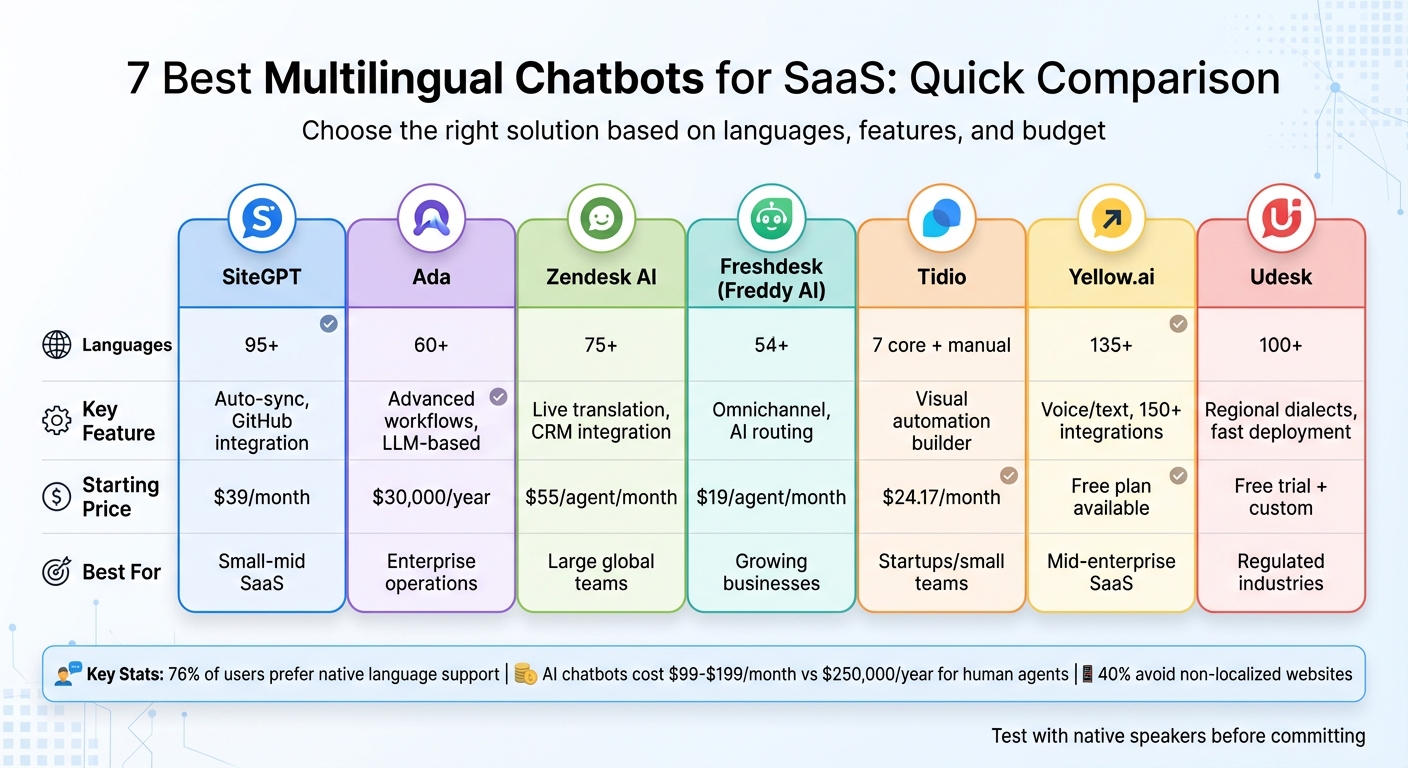
Multilingual Chatbot Comparison: Features, Pricing & Language Support for SaaS Platforms
1. SiteGPT
Language Support & Coverage
SiteGPT supports an impressive 95+ languages, making it a strong choice for businesses targeting diverse markets across Europe, Asia, and the Middle East. There are no extra charges for covering multiple languages, which is a major plus. The platform automatically detects the visitor's language from their first message and replies in the appropriate language - no need for extra configuration [14, 18]. This includes right-to-left (RTL) languages like Arabic, Hebrew, and Urdu, as well as regional dialects.
Its standout feature is the "train once, respond everywhere" approach. You can create an English knowledge base, and SiteGPT will provide accurate responses in any supported language - even if a user switches languages mid-conversation [2, 18].
On top of its language capabilities, SiteGPT packs in features tailored specifically for SaaS companies.
Key Features for SaaS
SiteGPT connects with 12+ data sources frequently used by SaaS businesses. These include GitHub repositories, YouTube tutorials, Zendesk help centers, Notion documents, and Google Drive folders. In fact, a January 2026 Fritz AI test on a live SaaS site revealed impressive results: weekly support ticket volume dropped from 43 to 24, and email opt-in rates jumped from 3.7% to 11.5%.
The platform also offers automatic content syncing - choose daily, weekly, or monthly updates - to ensure your documentation stays current across all languages whenever your English help docs are updated [14, 15]. For companies managing sensitive data, SiteGPT meets SOC 2 Type II, GDPR, and HIPAA compliance requirements.
"We've got the bot dialed in - we're using GPT-4, have an avenue for escalations to Zendesk, and so far I have no complaints."
– Brent Burrows II, Vice President – Retail & Sales at CBS Bahamas
Pricing & Accessibility
| Plan | Monthly Price | Messages/Month | Auto-Sync | Pages Supported |
|---|---|---|---|---|
| Starter | $39 | 4,000 | Manual | 1,000 |
| Growth | $79 | 10,000 | Monthly | 10,000 |
| Scale | $259 | 40,000 | Weekly | 50,000 |
| Enterprise | Custom | Custom | Daily | 500,000 |
All plans include access to the full suite of 95+ languages with no extra fees. Businesses can also opt for white-labeling at an additional $39/month, which is a cost-effective solution compared to competitors. Plus, annual billing offers a 40% discount [14, 16].
Best Use Case
SiteGPT shines for SaaS companies with extensive technical documentation and a global user base. It’s especially useful for businesses looking to avoid the expense of hiring multilingual support teams. With its quick 5-minute setup, the ability to train on sources like GitHub repositories and API documentation, and its support for video tutorials, SiteGPT is a powerful tool for developer-oriented products [14, 20]. For companies with frequently updated content, the auto-sync feature ensures changes are reflected quickly across all languages.
sbb-itb-e3aed85
2. Ada
Language Support & Coverage
Ada supports more than 60 languages, catering to major global markets and regional dialects. The platform employs two translation methods: LLM-based generation for 10 key languages (including Arabic, Chinese Simplified, Dutch, English, French, German, Italian, Portuguese, Spanish, and Swedish) and Google Translate for other supported languages.
The system automatically identifies a user's language from their first message, though for Latin-based languages, it may require over 20 characters to ensure accurate detection. Ada also offers full right-to-left (RTL) support for languages like Arabic and Hebrew, flipping UI components such as settings and loading bars to accommodate these languages. Additionally, it tailors content to specific regions, differentiating between variants like en-US and en-CA for precise localization.
Key Features for SaaS
Ada's Reasoning Engine™ coordinates multiple LLMs to handle intricate customer queries. With over 5.5 billion customer interactions processed across more than 85 countries, the platform achieves up to 84% automated resolution rates.
The Playbooks tool enables SaaS teams to create structured, multi-step workflows for tasks like billing and account upgrades, refunds, or identity verification - all without the need for rigid scripting. Meanwhile, Actions allow the AI agent to integrate with external APIs and business systems like Zendesk and Salesforce, enabling real-time updates and data retrieval. For example, Monday.com saw a 42% drop in average agent handle time after deploying Ada to autonomously resolve customer queries.
"With Ada, we know the automated resolution will continue to improve as the AI agent learns and grows. There's significant flexibility in making changes and improvements. The responses and the accuracy are phenomenal."
– Tal Gulst, Bot Manager, Monday.com
Pricing & Accessibility
Ada is built for enterprise-level operations. The company positions itself as ideal for organizations managing at least 300,000 customer service conversations annually. Pricing details aren’t publicly available - you’ll need to consult their sales team for a custom quote based on your specific needs and conversation volume.
That said, typical enterprise clients spend about $70,000 per year on Ada, with starting costs around $30,000 annually. Usage fees generally range from $1.00 to $3.50 per automated resolution. There’s no self-serve free trial; access requires a sales consultation and an enterprise contract.
This pricing model reflects Ada's focus on delivering advanced multilingual solutions for large-scale operations.
Best Use Case
Ada is a strong choice for high-volume SaaS companies with complex workflows and a global reach. For instance, IPSY, a beauty subscription service, achieved a 943% ROI in just four months by launching Ada's "Glam Bot" in only 12 days. Similarly, Loop Earplugs used Ada to handle workloads equivalent to 25 full-time employees, improving first response times by 194%.
If your SaaS business manages hundreds of thousands of customer interactions annually and requires deep CRM integrations with tools like Zendesk or Salesforce, Ada's multilingual capabilities and enterprise-level features make it a solid investment.
Next, we’ll explore Zendesk AI’s multilingual capabilities.
3. Zendesk AI
Language Support & Coverage
Zendesk AI offers impressive language capabilities, with its AI agents providing generative responses in 75 languages and expression-based detection in over 100 languages. This includes support for major global markets and right-to-left scripts like Arabic and Hebrew.
The system automatically detects a customer's language from the first message. If there's not enough text to determine the language, it defaults to the browser or app language until more context is gathered. It also features live conversation translation across 32 languages, while its intelligent triage - capable of identifying language, sentiment, and intent - supports 31+ languages.
Key Features for SaaS
Designed specifically for SaaS, IT, and HR, Zendesk AI can automate up to 30% of customer requests right out of the box. The Agent Copilot enhances productivity by providing full customer context, suggesting replies, and recommending next steps - potentially increasing team efficiency by 20%.
For instance, Jigsaw, led by Customer Experience Manager James Billett, reported a 35% reduction in ticket volume and a 20% decrease in response times after adopting Zendesk AI. Similarly, Motel Rocks cut its ticket volume by 50% and improved CSAT scores by 9.44%.
"We had our AI agent up and running in no time and we're improving it on a daily basis. And I feel confident that it gives customers the right answer."
– James Billett, Customer Experience Manager, Jigsaw
Pricing & Accessibility
Zendesk AI is offered through their Suite plans:
- Team: $55/agent/month (annual billing)
- Professional: $115/agent/month (annual billing)
- Enterprise: $169/agent/month (annual billing)
Each plan includes a set number of Automated Resolutions - 5, 10, and 15 respectively. Additional resolutions are available at $1.50 each (committed) or $2.00 pay-as-you-go. Advanced features, such as Agent Copilot, are available for an extra $50/agent/month, while Quality Assurance costs $35/agent/month. Early-stage SaaS companies may qualify for six months of free access through Zendesk's startup program, or they can explore open-source SaaS solutions to keep initial costs low.
This pricing structure, combined with its powerful AI features, makes Zendesk AI a flexible and scalable option for businesses.
Best Use Case
Zendesk AI is an excellent fit for businesses needing reliable, multilingual support with minimal setup time. It's particularly well-suited for SaaS companies already using Zendesk for ticketing and looking to enhance their operations with AI-driven automation. Its ability to detect and triage in over 100 languages makes it a standout choice for companies expanding into global markets.
Build a Multilingual AI Agent to Answer Customer Questions & Capture Leads Automatically
4. Freshdesk (Freddy AI)
Freshdesk's Freddy AI continues to shine as a strong contender in the realm of multilingual support for global SaaS platforms.
Language Support & Coverage
Freddy AI supports an impressive 54 languages for self-service bots and over 60 languages with its Live Translation assistant. It automatically selects the appropriate language based on the preferences of users and agents.
The scope of language support depends on the feature tier:
- Core AI features like summarization and intent detection work in English, German, Dutch, French, Spanish (EU and LATAM), and Portuguese (BR).
- Advanced tools such as sentiment analysis and the solution article generator cover around 25 languages, including Russian, Italian, Polish, Turkish, Chinese (Simplified/Traditional), Japanese, Korean, and Vietnamese.
- The Email AI Agent supports all these languages and adds Swedish to the list.
Key Features for SaaS
Freddy AI Copilot is designed to make customer support teams more efficient. Key features include:
- Writing Assistant: Helps agents craft better responses.
- Summary Generator: Reduces review time by 56%.
- Reply Suggester: Uses solution articles to suggest responses.
- Thank You Detector: Prevents tickets from reopening unnecessarily when customers send polite closing messages.
"We use Freddy to rephrase our conversations all the time. Freddy AI Copilot has significantly improved our customer interactions. We even updated a few of our traditional standard replies due to suggestions from Freddy." – Angela Thomas, Director of Customer Care
Freddy AI Copilot users have reported a 67% improvement in response quality and a 60% boost in agent productivity.
Another standout feature is the no-code Agent Studio, which allows teams to deploy AI agents across platforms like WhatsApp, Slack, Microsoft Teams, and Web Chat. setting up multilingual bots is straightforward - admins can add new languages by downloading the original script, translating it, and uploading the localized version.
Pricing & Accessibility
Freshdesk offers tiered pricing plans:
- Free Plan: For up to 2 agents.
- Growth: $19/agent/month (billed annually).
- Pro: $55/agent/month (billed annually).
- Enterprise: $89/agent/month (billed annually).
The Freddy AI Copilot add-on starts at $29/agent/month (annually) or $35/agent/month (monthly). Freddy Insights is currently free in beta with the purchase of at least one Copilot license.
For businesses that don’t need AI capabilities for their entire team, the platform offers a flexible add-on model, allowing companies to purchase Freddy AI Copilot for selected agents. Pro and Enterprise plans include 500 one-time AI Agent sessions, with extra sessions available at $49 per 100 sessions.
Best Use Case
Freshdesk with Freddy AI is a great fit for SaaS companies looking to balance affordability with advanced AI tools. It's especially useful for teams needing multilingual support without hiring native speakers for every region. With real-time translation in over 60 languages, flexible pricing, and the option to scale AI features gradually, it’s an excellent choice for growing businesses aiming to expand their AI communication tools without jumping into enterprise-level costs.
5. Tidio
Tidio offers multilingual support and chatbot solutions tailored for SaaS teams of various sizes, making it an accessible solution for businesses looking to streamline customer interactions.
Language Support & Coverage
Tidio comes with pre-translated language packs in seven widely used languages - English, French, German, Italian, Portuguese, Russian, and Spanish. For additional languages, users can manually translate and customize the widget text as needed.
The platform's automatic browser language detection ensures the chat widget displays in the visitor's preferred language without requiring manual adjustments. Its Lyro AI Agent supports numerous languages, with strong capabilities in English, Spanish, French, Portuguese, and German for automated customer interactions. However, Tidio does not currently offer automatic real-time translation for live agent chats.
Key Features for SaaS
Tidio's Lyro AI Agent is designed to handle up to 67% of customer conversations using natural language processing and company-specific knowledge. It also guarantees at least a 50% resolution rate - or you get your money back.
Its multichannel ticketing system consolidates messages from various platforms, including live chat, email, WhatsApp, Instagram, and Messenger, into a single dashboard for streamlined management. Real-time visitor tracking allows teams to see what pages users are browsing, enabling timely assistance or sales engagement.
For automation, Tidio offers a no-code visual builder with over 40 templates to simplify tasks like lead qualification, sales funnel management, and repetitive customer support processes. It integrates seamlessly with popular SaaS tools such as HubSpot, Zendesk, Pipedrive, and Zapier, and also provides an OpenAPI for custom integrations.
Pricing & Accessibility
Tidio's pricing model is modular, charging only for "billable conversations", which are responses made by human agents. Automated responses don't count toward this total.
- Free Plan: $0/month; includes 50 billable conversations and 50 Lyro AI conversations.
- Starter: $24.17/month (billed annually); includes 100 billable conversations.
- Growth: Starts at $49.17/month (billed annually); offers 250+ billable conversations and advanced analytics.
- Plus: Starts at $749/month; includes multi-project support and a dedicated success manager.
- Premium: Custom pricing; includes 3,000+ Lyro conversations and a guaranteed 50% AI resolution rate.
- Lyro AI Agent Add-on: Starts at $32.50/month for 50 monthly AI conversations.
A 7-day free trial is available, allowing access to all premium features without requiring a credit card.
Best Use Case
Tidio is particularly well-suited for small to mid-sized SaaS companies looking for multilingual support that’s easy to implement and budget-friendly. Trusted by over 300,000 customers and rated 4.6/5 from more than 1,879 reviews, it’s a proven solution for teams seeking a quick setup and seamless integration with platforms like Shopify and WordPress. The free plan makes it especially appealing for startups experimenting with multilingual support before committing to a paid plan.
6. Yellow.ai
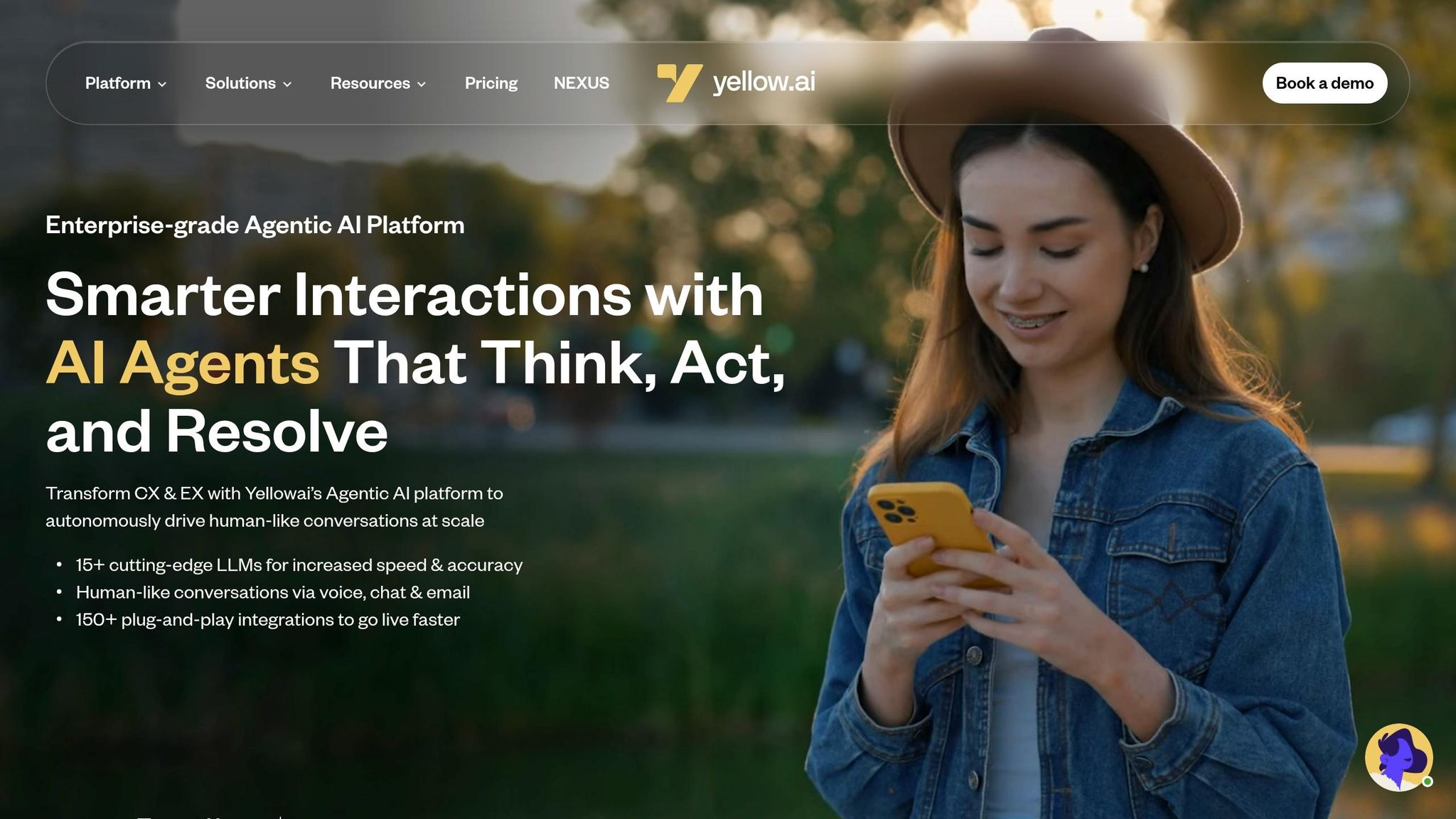
Yellow.ai is making waves in the multilingual chatbot space with its extensive language support and seamless integration features.
The platform impresses with support for over 135 languages, positioning itself as a top choice for SaaS businesses looking to cater to global audiences. Its "Agentic AI" architecture, powered by over 15 large language models, ensures it can maintain context and intent across languages. Handling more than 16 billion customer conversations annually, it boasts a remarkably low hallucination rate of under 1%.
Language Support & Coverage
Yellow.ai’s robust framework includes text capabilities, speech-to-text (STT) and text-to-speech (TTS) solutions, and advanced tools like knowledge mining and sentiment analytics. These features enable effective communication in major global languages. The platform also includes automatic language detection, which identifies a user’s preferred language at the start of a conversation and adjusts responses accordingly. For added flexibility, businesses can choose between auto-translation services like Google Translate or manually configured translation keys for greater accuracy.
Key Features for SaaS
Yellow.ai integrates with over 150 enterprise systems, including Salesforce, Zendesk, HubSpot, ServiceNow, Jira, and SAP. It also supports 35+ communication channels, such as website chat, mobile apps, WhatsApp, Instagram, email, SMS, and natural voice AI. Its "Agentic Discovery" feature takes automation a step further by pulling historical data from knowledge bases to create AI agents without requiring manual setup.
Companies like VIPdesk have seen impressive results with Yellow.ai. According to Chief AI Officer Jeff Kramp, the platform was deployed quickly and now automates over 70% of customer interactions. Waste Connections also benefited by implementing an after-hours voice AI agent, which automated routine inquiries, saving millions of dollars in just one year while maintaining high customer satisfaction.
"With Yellow.ai, we moved from endless delays to delivering real results. In just six weeks, we launched a fully functioning AI-powered chat that now automates more than 70% of customer interactions."
- Jeff Kramp, Chief AI Officer, VIPdesk
Pricing & Accessibility
Yellow.ai offers flexible pricing options to accommodate different business needs.
- Free Plan: Includes one AI agent and up to 500 monthly chat sessions, with additional resolutions billed at $0.99 each.
- Enterprise Plan: Provides unlimited AI agents and sessions across all supported channels, with custom pricing available through the sales team.
The platform also meets stringent security standards, including SOC2, GDPR, ISO 27001, HIPAA, and PCI-DSS compliance.
Best Use Case
Yellow.ai is an excellent choice for mid-sized and enterprise SaaS companies operating in global markets. Its extensive language support aligns perfectly with research showing that 76% of shoppers prefer buying when information is available in their native language. With its Free Plan, even smaller teams can test the platform’s core features before scaling up to enterprise-level deployments.
7. Udesk
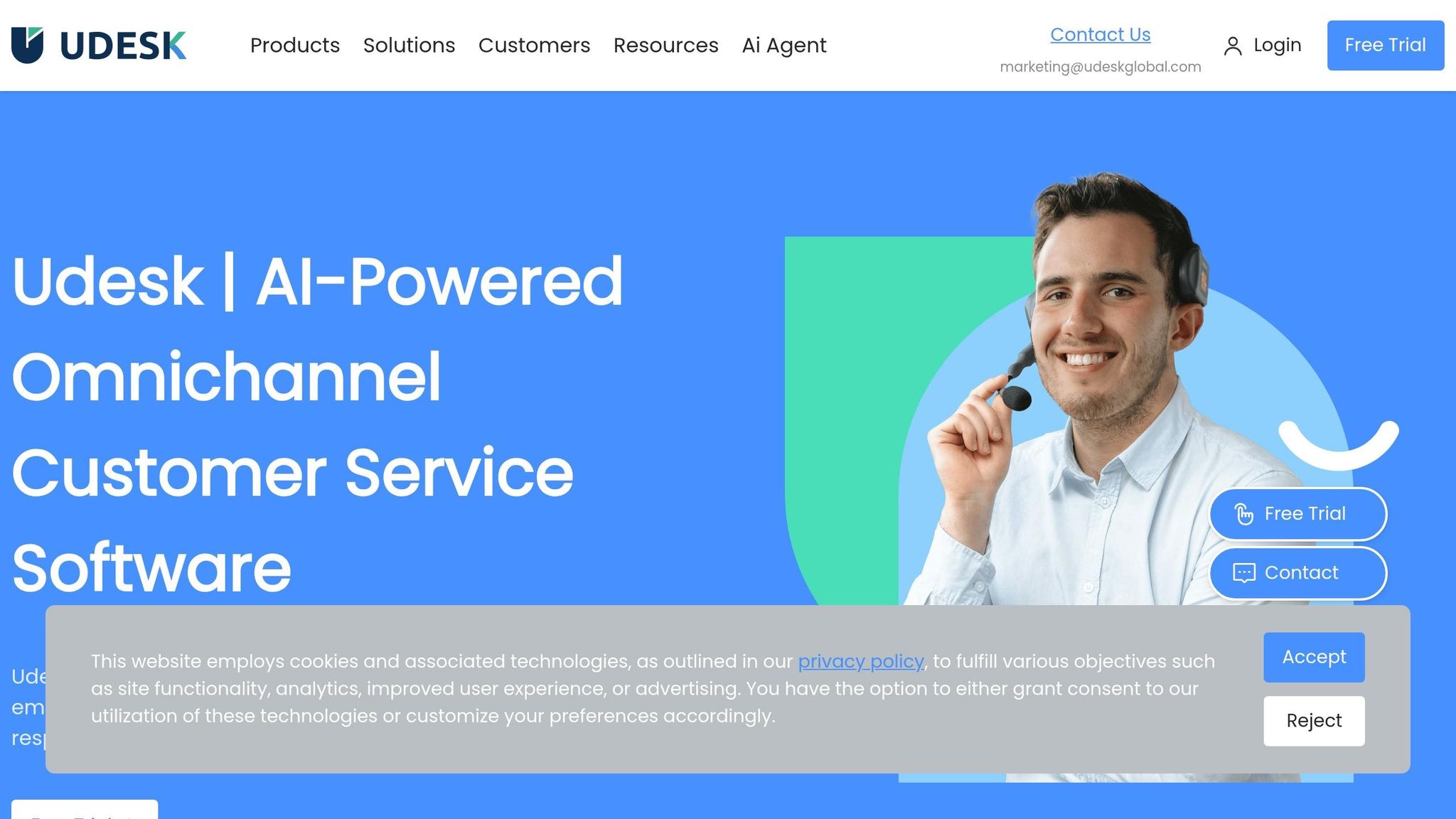
Udesk wraps up our list with impressive multilingual capabilities and advanced technical features that cater to global businesses.
The platform supports over 100 languages and 11 regional dialects, including less commonly served languages like Swahili, Vietnamese, and Arabic. Its hybrid AI architecture combines proprietary large language models with smaller, industry-specific ones, delivering 98%+ accuracy for technical and specialized terminology. Real-time translation is lightning-fast, completing in just 700 milliseconds. As of 2026, Udesk holds a 35%+ market share in the global AI customer service market and is trusted by more than 50,000 businesses worldwide. Below, we’ll explore Udesk's language coverage, standout features, pricing structure, and ideal applications.
Language Support & Coverage
Udesk’s support for over 100 languages and 11 regional dialects is enhanced by sentiment analysis, which adapts responses to cultural nuances - key for maintaining brand reputation. According to Gartner's 2026 report, 92% of global enterprises now prioritize AI platforms like Udesk to break down language barriers. The AI Agent autonomously resolves 90% of routine queries, such as order tracking and refund processing, across all supported languages.
Key Features for SaaS
Udesk integrates 30+ global marketing and communication channels - including WhatsApp, TikTok, email, voice, and SMS - into a single dashboard, preserving conversation histories even when customers switch channels. This feature addresses a major pain point for 68% of global consumers, who dislike repeating themselves when switching platforms. The platform’s AI-driven routing ensures queries are assigned based on factors like language, complexity, and customer priority. Deployment is also highly efficient: a multilingual knowledge base can be set up in just 5 minutes, and AI Agent capacity can scale during peak traffic in under 3 hours.
In 2026, Watsons, a global retailer, implemented Udesk’s AI chatbot across its online channels. The chatbot now resolves 85% of common customer issues, significantly reducing the workload on human agents while cutting operational costs. Similarly, manufacturing leader 3M used Udesk to automate outbound call scripting for supplier and customer screening, reducing manual labor by 70% with robots managing over 30 tailored scenarios.
Pricing & Accessibility
Udesk’s tiered pricing approach allows businesses to pay only for the features they need. The platform accommodates companies of all sizes, from small startups to large enterprises, with deployment options available in public, private, and hybrid cloud configurations. A free trial is available for businesses to test the platform before committing. Udesk also meets strict compliance standards, including ISO 27001, ISO 27701, GDPR, CCPA, and China’s Data Export Security Assessment.
Best Use Case
Udesk focuses on facilitating smooth global communication. It’s an excellent choice for mid-sized to enterprise SaaS companies operating in regulated industries or serving international markets. With its deep support for over 100 languages, persistent cross-channel conversation history, and robust compliance credentials, Udesk is particularly suited for sectors like finance, healthcare, and retail. Its ability to handle high volumes of routine tasks while respecting cultural sensitivities makes it a standout option for businesses aiming to balance automation with a quality customer experience.
Feature Comparison Table
Here’s a snapshot of how various SaaS tools for modern businesses stack up in terms of language support, standout features, pricing, and their ideal use cases.
| Chatbot | Language Support | Key Features | Pricing Tiers | Best Use Case |
|---|---|---|---|---|
| SiteGPT | Over 95 languages with automatic detection | Contextual translation and mid-conversation language switching | Free tier; paid plans start at $39/month | Perfect for small to mid-sized SaaS companies testing multilingual features affordably |
| Ada | Multiple languages supported | Handles high-volume queries with advanced NLP for intent detection | Competitive entry-level pricing | Great for mid-market and enterprise companies scaling global customer support |
| Zendesk AI | Enterprise-grade multilingual support | Complex workflows, broad integrations, and detailed reporting | Premium pricing for enterprise clients | Tailored for large enterprises and global teams needing reliable configurations |
| Freshdesk (Freddy AI) | Multilingual support across channels | Unified inbox for omnichannel support with AI-driven routing | Free tier; full features on Pro and Enterprise plans | Suited for growing businesses managing omnichannel support from one platform |
| Tidio | Multiple languages with real-time translation | Quick setup, live chat integration, and basic automation for small teams | Affordable starter plans with limits on lower tiers | Ideal for startups and small businesses needing fast deployment |
| Yellow.ai | Wide range of languages, including voice and text | Customizable multilingual solutions | Enterprise pricing with scalable options | Designed for global enterprises with extensive language needs |
| Udesk | Multilingual support with regional customization | Cross-channel integration and flexible deployment | Tiered pricing, including a free trial; supports public, private, or hybrid cloud setups | Best for mid-sized to enterprise SaaS companies in regulated industries needing cultural sensitivity |
These multilingual chatbots use NLP to ensure accurate intent detection and natural responses. Many platforms allow businesses to train their AI agents in one language - often English - and then enable support in over 95 languages without requiring separate training for each.
Conclusion
When selecting a multilingual chatbot, consider your company’s size, budget, and global reach. For startups or micro-SaaS businesses exploring international markets, SiteGPT ($39/month) and Tidio offer cost-effective options with extensive language support. Mid-sized companies scaling their customer support operations might find Ada or Freshdesk (Freddy AI) ideal for their automation capabilities and omnichannel features. Meanwhile, enterprises with complex, global operations can rely on Zendesk AI, Yellow.ai, or Udesk for their advanced compliance and customization options.
The cost comparison is striking: hiring human support for five languages can exceed $250,000 annually, whereas AI chatbots provide a much more affordable alternative. And with 40% of consumers unwilling to purchase from a website that doesn’t support their language, offering multilingual support directly influences user trust and conversion rates - especially crucial for SaaS platforms.
Before committing to a solution, test it with native speakers in your target markets to ensure it handles cultural nuances effectively. If your audience includes Middle Eastern customers, verify that the platform supports right-to-left (RTL) languages like Arabic and Hebrew.
Ultimately, aligning your chatbot choice with your business’s scale, budget, and target audience is essential. For more SaaS tools to enhance your operations - from billing systems to analytics - check out the All SaaS Software Directory. Curated by John Rush, this resource provides detailed comparisons across categories like communication, ecommerce, and software development, helping you find the perfect fit for your tech stack and budget.
FAQs
How do I choose the right multilingual chatbot for my SaaS size and budget?
Choosing the right multilingual chatbot depends on several factors, including the size of your SaaS business, your budget, and the level of support you require. If you're running a smaller operation, look for affordable, no-code options that start at around $19 per month - these can be a great fit for limited resources. On the other hand, larger businesses aiming for global expansion should prioritize scalable platforms that offer advanced multilingual capabilities.
Key features to assess include automation capabilities, the range of supported languages, and pricing plans. Make sure the tool you choose aligns with both your current needs and your long-term growth objectives, all while staying within your budget.
How can I test translation quality and cultural fit before going live?
To ensure top-notch translation quality and cultural alignment, combine professional translation services with machine translation tools. This approach helps verify both accuracy and a smooth, natural flow in the content. When dealing with cultural nuances or less commonly spoken languages, it's important to use transfer strategies and carefully evaluate localization efforts.
For chatbot performance, rely on benchmarking frameworks that analyze linguistic and cultural differences. These frameworks help assess quality and ensure the chatbot is appropriate for its intended audience before it goes live.
What integrations should a SaaS multilingual chatbot support?
A SaaS multilingual chatbot needs to seamlessly connect with essential systems like CRM platforms to bring together marketing, sales, and support efforts. It should also integrate with communication channels such as live chat, messaging apps, and email. By incorporating AI tools, it can enhance workflows and streamline help desk operations. Additionally, connecting with internal data systems and analytics is crucial for tracking performance and offering personalized, scalable support across various customer interactions.