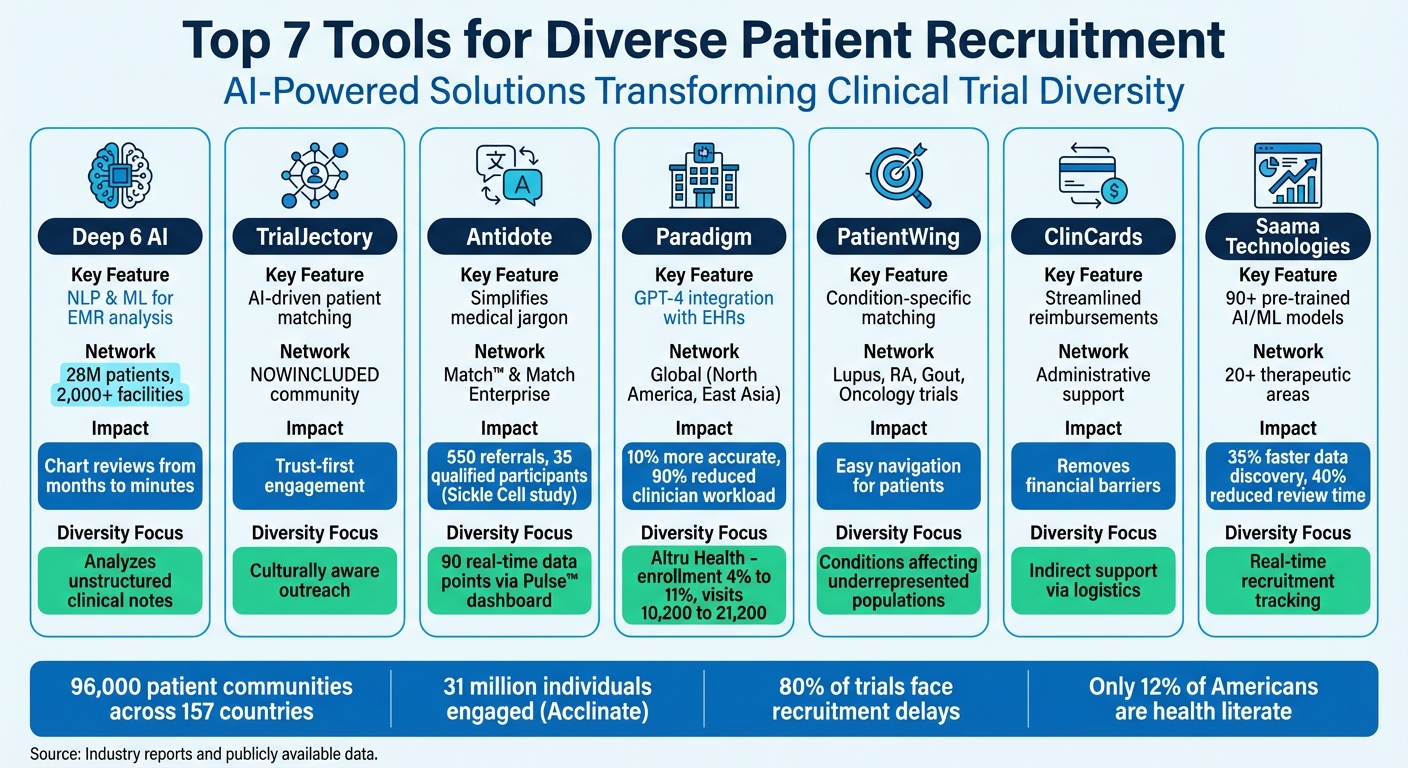
- Deep 6 AI: Uses Natural Language Processing (NLP) and Machine Learning (ML) to analyze patient data from medical records, enabling precise trial matching and identifying diverse populations.
- TrialJectory: AI-driven platform connecting patients to suitable trials while emphasizing trust-based engagement with underrepresented groups.
- Antidote: Simplifies trial descriptions for patients, improves outreach, and uses real-time data insights to track diversity metrics.
- Paradigm: Integrates trials into community health systems, leveraging GPT-4 to improve data accuracy and expand access in underserved areas.
- PatientWing: Focuses on conditions affecting specific populations, offering easy-to-navigate tools for patients and sponsors.
- ClinCards: Addresses financial and logistical barriers by streamlining participant reimbursements, indirectly supporting recruitment.
- Saama Technologies: Combines AI tools to accelerate patient identification, track recruitment progress, and improve representation in trials.
These SaaS solutions are reshaping how clinical trials recruit participants, ensuring broader representation while meeting regulatory diversity requirements.
7 AI-Powered Clinical Trial Recruitment Tools Comparison
1. Deep 6 AI

AI and Data Analytics Capabilities
Deep 6 AI leverages Natural Language Processing (NLP) and Machine Learning (ML) to sift through both structured and unstructured data in Electronic Medical Records (EMRs). This includes information from clinical notes and radiology reports, making it a powerful tool for data analysis. The platform connects an impressive 28 million patients across more than 2,000 facilities, enabling precise patient matching for clinical trials.
One of its standout features is its ability to cut down the time needed for chart reviews from months to mere minutes. This is crucial, given that 80% of clinical trials face delays due to recruitment challenges. By streamlining this process, Deep 6 AI directly addresses one of the biggest hurdles in clinical research timelines. As Wout Brusselaers, CEO and Founder of Deep 6 AI, puts it:
"The majority of patients and their physicians are unaware of clinical trials opportunities, which means finding an eligible patient can be like finding a needle in a haystack".
Focus on Diversity and Inclusion
Deep 6 AI takes an innovative approach to closing diversity gaps in clinical trials. Unlike traditional methods that rely heavily on ICD codes, the platform dives deeper by analyzing unstructured clinician notes. This capability ensures that patients from diverse backgrounds, who might otherwise be missed, are identified for trials. It also allows sponsors and CROs to evaluate site feasibility before trials begin, ensuring that investigative sites have the patient populations needed to meet diversity goals.
In May 2022, Deep 6 AI teamed up with WCG to combine its AI-driven technology with WCG's extensive network of 3,300 research institutions and 5,000 biopharma sponsors. Nick Slack, President of WCG, highlighted the importance of this partnership:
"Our partnership with Deep 6 AI will bring together the expertise, capabilities, and technology to break down silos, connect research stakeholders, and... ensure patient and provider access to clinical trials is more equitable and diverse".
This collaboration is a game-changer for equitable access, bridging gaps between research stakeholders and enhancing the platform’s ability to match diverse patients to appropriate trials.
Ease of Patient-Trial Matching
Deep 6 AI shines in its ability to match patients to trials with complex eligibility criteria, particularly in specialized fields like oncology, where finding suitable participants is notoriously difficult. To further enhance this process, the company partnered with Graticule to create algorithms that not only qualify and prioritize eligible patients quickly but also reduce the workload for hospital IT teams. Importantly, patient privacy is safeguarded through anonymous data processing.
sbb-itb-e3aed85
2. TrialJectory
AI and Data Analytics Capabilities
Building on the advanced analytics seen with Deep 6 AI, TrialJectory takes trial matching to the next level with its AI-powered platform. Designed with patients in mind, TrialJectory uses AI to analyze patient profiles and automatically connect them to clinical trials that fit their needs. This eliminates the need for manual selection, making the recruitment process faster and more efficient.
Community Outreach and Engagement Features
TrialJectory doesn’t just rely on data - it also focuses heavily on community engagement to reach underrepresented populations. Through its parent company, Trialbee, TrialJectory has teamed up with Acclinate to improve diversity in clinical trials. This partnership leverages the NOWINCLUDED community, a trust-based network aimed at engaging historically underrepresented groups. While Deep 6 AI shines in extracting data from EMRs quickly, TrialJectory combines precise technical matching with culturally aware outreach. The platform emphasizes a "Trust-First" strategy, blending culturally relevant engagement methods with real-time behavioral data to identify participants ready for trials.
3. Antidote
Simplifying Patient-Trial Matching
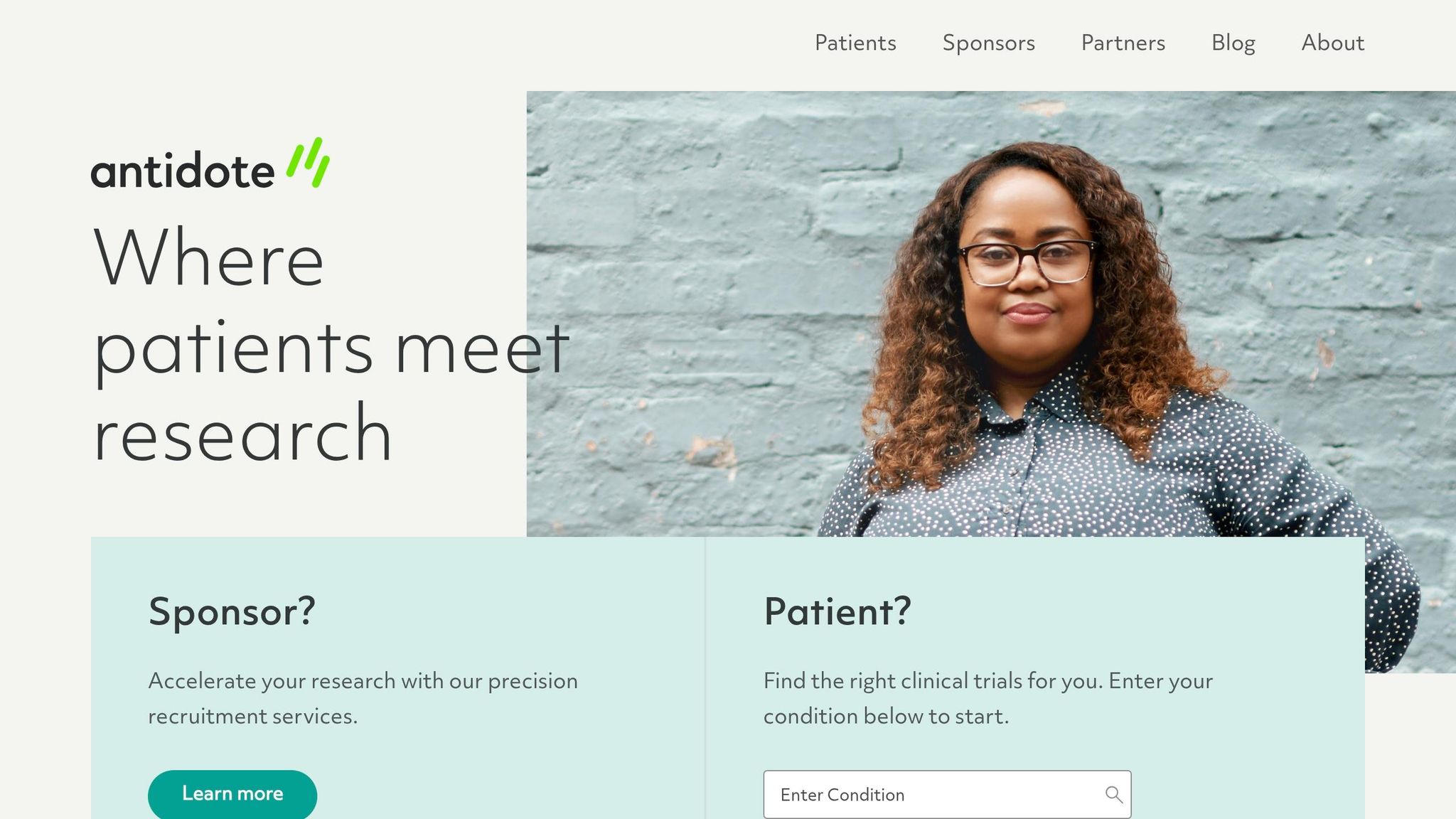
Antidote takes on the challenge of simplifying medical jargon, a significant barrier for many. With only 12% of Americans considered health literate, navigating complex trial descriptions on platforms like ClinicalTrials.gov can be daunting. Antidote Match™ steps in by translating intricate eligibility criteria into straightforward, patient-friendly questions. Additionally, its Match Enterprise tool allows sponsors to evaluate eligibility across multiple trials while notifying patients about new opportunities.
This streamlined, patient-first approach also supports a broader effort to connect with diverse communities.
Commitment to Diversity and Inclusion
Understanding the importance of representation in clinical trials, Antidote prioritizes diversity in its recruitment strategies. By leveraging precision recruitment methods, including tailored imagery, culturally relevant messaging, and third-party data, the platform successfully engages underrepresented groups. A notable example occurred in September 2022, when Antidote partnered with an electronic medical records company to recruit participants for a Sickle Cell Disease real-world evidence data set. This effort resulted in 550 referrals and 35 qualified participants.
Antidote also collaborates with the National Minority Health Association (NMHA) to implement community-based mobilization strategies. These strategies previously facilitated the delivery of 62,000 COVID-19 vaccines to underserved populations. CEO Laurent Schockmel emphasized the importance of this mission, stating:
"The FDA's effort to increase racial and ethnic diversity in clinical trials is a clarion call to the industry. Change is here. We're here to help".
Leveraging AI and Data Analytics
Antidote’s Pulse™ dashboard offers real-time insights into 90 data points, updated hourly, giving study teams a clear view of demographic representation and recruitment performance. This tool allows teams to quickly identify underperforming sites and adjust outreach strategies mid-campaign to meet diversity goals. Its user-friendly visualizations make it easier to spot representation gaps and take immediate corrective actions.
4. Paradigm
AI and Data Analytics Capabilities
Paradigm works seamlessly with community health system EHRs to gather a wide range of patient data. By using GPT-4, the platform can make sense of fragmented patient information with impressive efficiency. Tests reveal that Paradigm's AI is 10% more accurate than traditional models and reduces clinician workload by a staggering 90%.
Jonathan Hirsch, Chief Strategy and Growth Officer at Paradigm Health, highlighted the platform's impact:
"The accuracy of OpenAI was better than our existing deployment and optimization of industry best-practice expert-trained models, and it was sometimes better than our trained clinicians".
This advancement sets the stage for stronger integration within community health systems.
Focus on Diversity and Inclusion
Paradigm's AI tools aren't just about efficiency - they're also key to expanding access. By embedding trials within community health systems, the platform reaches patients who might otherwise miss out on research opportunities. Its global network spans regions like North America and East Asia, effectively addressing challenges faced by rural and underserved populations. For instance, at Altru Health System, a rural cancer center, Paradigm boosted pre-screening visits from 10,200 to over 21,200 annually, nearly tripling trial enrollment rates from 4% to 11%.
Ashlee Dagoberg, Manager of Research Program at Altru Health System, shared:
"This has a profound impact on patients' lives in a rural community that otherwise would not have access to clinical research as a care option".
This ability to bridge gaps in access complements Paradigm's AI-driven capabilities.
Ease of Patient-Trial Matching
Paradigm simplifies the process of matching patients to clinical trials by embedding these trials into routine care. Automated screening tools identify eligible patients during their regular visits. At Highlands Oncology, this approach led to a 45% increase in trial enrollment over two years. Adam Torres, Director of Research Development at Highlands Oncology, noted:
"Highlands increased clinical trial patient enrollment by 45% over the last two years, while also reducing the burden on the research department".
5. PatientWing
Focus on Diversity and Inclusion
PatientWing emphasizes reaching underrepresented groups by highlighting studies for conditions that disproportionately impact these populations. For example, the platform features trials for conditions like Lupus, Lupus Nephritis, Rheumatoid Arthritis, and Gout. Patients can also find studies in other areas, including oncology trials for Leukemia and Lymphoma, rare pediatric conditions like Osteogenesis Imperfecta, and chronic illnesses such as IgA nephropathy and Epilepsy.
This approach creates a straightforward way for patients to find and connect with relevant studies.
Ease of Patient-Trial Matching
The platform simplifies the process of finding trials by allowing patients to search based on their specific conditions. Filters and preliminary eligibility criteria - such as "uncontrolled gout" or "treatment-resistant lupus" - help users quickly determine if they might qualify for a study. Additionally, customized tools for sponsors, CROs, and research sites make enrollment more efficient and boost the visibility of available trials.
But PatientWing doesn’t stop at matching. It also helps patients better understand what clinical research involves.
Community Outreach and Engagement Features
PatientWing strengthens its recruitment efforts through partnerships with various organizations while prioritizing patient education. By offering straightforward and accessible information about clinical research, the platform helps patients feel more informed and confident before deciding to participate in a study. This focus on education builds trust and encourages greater involvement in clinical trials.
6. ClinCards
Focus on Diversity and Inclusion
ClinCards provides limited data on how it directly impacts trial diversity. However, it plays a role in addressing financial and logistical challenges, which are often significant barriers for underrepresented groups in clinical research. Tackling these issues is a key step in encouraging broader participation in trials.
Ease of Patient-Trial Matching
While ClinCards doesn’t offer direct patient-trial matching, its real strength lies in simplifying administrative tasks, especially participant reimbursement. By streamlining these processes, the platform indirectly supports recruitment efforts for clinical trials. This operational efficiency complements platforms that focus on direct patient matching, contributing to more inclusive recruitment strategies overall.
7. Saama Technologies
AI and Data Analytics Capabilities
Saama Technologies has developed a powerful suite of tools aimed at improving patient recruitment in clinical trials, with a focus on diversity. Over the past decade, the company has created more than 90 pre-trained AI/ML models tailored specifically for life sciences, spanning 20+ therapeutic areas. One standout feature is their Data Hub, which accelerates data discovery by 35%, while their Patient Insights tool reduces patient data review time by 40%. Together, these tools make it easier and faster to identify diverse patient populations.
Another key feature is the Smart Data Quality (SDQ) tool, which automates data capture and validation, saving over 20,000 hours of manual work. This ensures that data is accurate and reliable, reducing errors that could exclude qualified patients.
Focus on Diversity and Inclusion
Saama's Operational Insights tool provides real-time updates on clinical trial progress, allowing sponsors to track recruitment metrics and monitor representation as trials progress. This real-time visibility helps research teams quickly identify underrepresented demographic groups and adjust their strategies to improve inclusivity. By consolidating clinical data from various sources, the Data Hub simplifies the discovery of patient cohorts that might otherwise be missed in fragmented systems. This centralized approach not only enhances diversity but also improves the efficiency of patient identification.
Simplifying Patient-Trial Matching
Saama's analytics tools are designed to make patient-trial matching faster and more efficient. The combination of the Patient Insights tool and the Data Hub automates the review process and centralizes patient information, significantly reducing the workload for clinical teams. This streamlined process accelerates the identification of eligible participants. Additionally, Saama's AI-Powered Document Generator cuts content drafting time by 30%, allowing teams to focus more on recruitment efforts.
Enhancing Diversity in Clinical Trials: Implementation of Diversity Plans
Conclusion
The seven SaaS tools highlighted have reshaped clinical trials, driving progress in both diversity and efficiency through AI-powered predictive intelligence, community outreach, and the use of real-world data. Automated sourcing engines now connect with 96,000 patient communities across 157 countries, while platforms like Acclinate have engaged 31 million individuals with culturally tailored content.
These solutions go beyond simplifying recruitment - they also measure trust metrics effectively. As Acclinate states:
"Trust is the new enrollment driver. Representation is a requirement. Behavioral data is the differentiator".
By converting trust signals into measurable benchmarks and comparing diversity metrics with historical data, these tools help sponsors cut down enrollment delays and meet FDA Diversity Action Plan standards.
Decentralized trial models and protocols shaped by patient input are extending studies to rural and underserved areas. At the same time, real-time enrollment tracking allows teams to quickly adjust strategies to close representation gaps.
For additional healthcare recruitment tools and to explore SaaS solutions advancing clinical trial diversity, check out the All SaaS Software Directory at https://saassoftware.org.
FAQs
How do these tools protect patient privacy when using EHR data?
These tools protect patient privacy by using HIPAA-compliant de-identification techniques. This involves removing or anonymizing personal details like names, dates, and location data to reduce the chances of re-identification. Such steps are crucial for keeping sensitive information secure while adhering to privacy laws.
What is the best tool for improving trial diversity in underserved communities?
Acclinate's platform stands out for its ability to improve trial diversity, particularly in underserved communities. By combining community trust with advanced AI and machine learning tools, it delivers predictive and representative data. At the same time, it prioritizes meaningful community engagement to help address health disparities.
What does the FDA Diversity Action Plan mean for recruitment?
The FDA Diversity Action Plan mandates that sponsors develop and carry out legally binding diversity plans. These plans are designed to increase the participation of underrepresented racial and ethnic groups in clinical trials, focusing initially on late-stage protocol submissions. The goal is to encourage research practices that are more inclusive and fair.